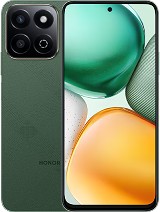
Honor X7c review
This phone suits someone in a price-sensitive market who needs a large screen, won't tolerate regular charging breaks, and does light work—web browsing, messaging, social media, streaming. Skip it if you game seriously, take selfies you care about, or expect a phone that multitasks without pause.
This review is based on Honor’s published specifications and public benchmark data for the Honor X7c, and the rating is spec-based. GoSolo does not physically test devices; where we estimate real-world behaviour such as battery life or charge time, we say so. How we rate phones.
Overview
The Honor X7c is a straightforward 5G budget phone with a large 120Hz display and a full day of battery life, but the Snapdragon 4 Gen 2 and basic camera setup mean it's light-duty only—good if you mostly need to scroll and message, less so if you game or demand quick performance.
Design & build
At 193 grams and 8.2mm thick, the X7c is solid and manageable in hand despite the 6.8-inch frame. The Aluminosilicate glass front and IP64 rating handle dust and splashes without fuss, though this isn't a phone you'd dunk in a pool. The side-mounted fingerprint sensor is quick enough for daily unlock, and dual Nano-SIM slots let you keep two numbers active. For a phone at this price, the build feels intentional rather than cheap, though it clearly cuts corners compared to what mid-range buyers expect in 2025.
Display
The 6.8-inch 1080p TFT LCD with 120Hz refresh and 850 nits peak brightness is one of the X7c's better choices. Scrolling is smooth, and you can actually read the screen in direct sunlight without squinting—650 nits would struggle here. Yes, it's TFT, not OLED, so blacks won't pop and battery efficiency lags behind modern AMOLED rivals, but at this price tier and in this size class, it's the right trade-off. The 389 ppi density is fine for text and video at normal viewing distance; you won't notice pixelation.
Performance
The Snapdragon 4 Gen 2 with Adreno 613 is entry-level silicon. It handles scrolling, messaging, streaming, and casual apps without hiccup, but sustained gaming, video editing, or heavy app switching reveals its limits. Genshin Impact and similar titles run at low-to-medium settings, not high. This isn't a phone for someone who loads 20 apps and forgets about it; you'll feel the lag if you multitask hard. For the people this phone targets—those in emerging markets who want a big screen and basic internet access—it's fit for purpose. For power users, it's a compromise.
Software
Android 14 with Honor's MagicOS 8 layer brings useful features like AI call screening and gesture controls, but it also adds bloat that eats RAM and battery. The 4GB base RAM variant will feel sluggish if you open more than a few apps at once; stick with the 8GB model if you can. Updates are not a given on a budget device like this, so expect security patches for a year or so, then a slow fade. The software is clean enough to not actively annoy, but it's not the reason to buy this phone.
Camera
The 50MP f/1.8 main sensor with PDAF shoots usable daylight photos with decent color and reasonable sharpness. Low-light stills are passable thanks to the wide aperture, though noise creeps in faster than on costlier phones. The 5MP selfie, though, is where Honor cut too deep. It's adequate for a quick selfie or a video call, but group shots lose detail and video calls show every skin texture. At this price, rivals now offer 13MP or 16MP selfie cameras as standard; this feels like a deliberate cost-save that buyers in this tier actually notice. Video maxes out at 1080p@30fps, which is fine but not ahead of 2025 expectations.
Battery & charging
The 5200mAh battery pairs well with the 120Hz display to deliver about a full day on typical use—social media, messages, some video. Heavy use will drain it to 10–15% by evening; light use gets you to bedtime with 20–30% left. That's solid for the capacity and class. The 35W wired charging tops the battery in roughly 50 to 65 minutes, which is adequate but feels slow in an era when sub-$200 rivals are hitting 65W to 100W. There's no wireless charging, so you'll always need the cable. For someone who charges overnight, it's fine; for people who top up during the day, it's a frustration.
Value & verdict
At roughly 150 EUR, the X7c undercuts most peers by 20–30%, which matters in emerging markets where that gap is real money. You're getting a large, bright display, reliable all-day battery, and 5G connectivity without paying flagship prices. The Snapdragon 4 Gen 2 and weak selfie camera are honest trade-offs at this price, not surprises. The slow charging is more defensible given the lower cost. The phone works as a big-screen, long-battery internet device; it just won't impress anyone chasing speed or photography.
Verdict
This phone suits someone in a price-sensitive market who needs a large screen, won't tolerate regular charging breaks, and does light work—web browsing, messaging, social media, streaming. Skip it if you game seriously, take selfies you care about, or expect a phone that multitasks without pause.
- Large 6.8-inch 120Hz display that stays readable in sunlight without overheating your hand
- 5200mAh battery lasts a full day on typical use without requiring a midday charge
- 50MP main camera with f/1.8 aperture and PDAF handles daylight shooting and low-light stills reasonably for the price
- Honest 5G connectivity and dual-band Wi-Fi, with a 3.5mm jack and NFC still included
- Entry-level Snapdragon 4 Gen 2 makes sustained gaming and heavy multitasking sluggish; not a phone you load up with apps and forget
- 5MP selfie camera is noticeably weak for video calls or group shots, a step behind what rivals at this price offer now
- 35W charging is slow by 2025 standards—peers in this category have hit 65W to 100W, making the 50–65 minute top-up feel draggy
Honor X7c Key Specifications
The essentials at a glance. See the full spec sheet.
| Released | 2025, August 18 |
|---|---|
| Display | 6.8 inches, 111.3 cm2 (~86.8% screen-to-body ratio), TFT LCD, 120Hz, 850 nits (peak) |
| Resolution | 1080 x 2412 pixels, 20:9 ratio (~389 ppi density) |
| Chipset | Qualcomm SM4450 Snapdragon 4 Gen 2 (4 nm) |
| RAM & storage | 256GB 4GB RAM, 256GB 8GB RAM |
| Main camera | 50 MP, f/1.8, (wide), PDAF Auxiliary lens |
| Selfie camera | 5 MP, f/2.2, (wide) |
| Battery | 5200 mAh |
| Charging | 35W wired |
| Software | Android 14, MagicOS 8 |
| Dimensions | 166.9 x 76.8 x 8.2 mm (6.57 x 3.02 x 0.32 in) |
| Weight | 193 g (6.81 oz) |
| Durability | IP64 dust tight and water resistant (water splashes) |
| Network | GSM / HSPA / LTE / 5G |
| NFC | Yes (market/region dependent) |
| USB | USB Type-C 2.0, OTG |
Honor X7c FAQ
Common questions, answered from the spec sheet.
Does the X7c support 5G?
Yes. The X7c supports 5G networks.
What chipset does the X7c use?
The X7c runs on the Qualcomm SM4450 Snapdragon 4 Gen 2 (4 nm).
What display does the X7c have?
A 6.8 inches, 111.3 cm2 (~86.8% screen-to-body ratio) TFT LCD, 120Hz, 850 nits (peak), 1080 x 2412 pixels, 20:9 ratio (~389 ppi density).
How big is the X7c battery?
The X7c has a 5200 mAh battery. Charging is rated at 35W wired.
Does the X7c have NFC?
Yes, the X7c has NFC.
Is the X7c water resistant?
The X7c carries a IP64 dust tight and water resistant (water splashes) rating.
Does the X7c support a microSD card?
No, the X7c does not support expandable storage.
Does the X7c have a headphone jack?
Yes, the X7c has a 3.5mm headphone jack.
Alternatives to consider
If the X7c isn’t quite right, these are the closest calls.

X5c

X6c

Play 60A

Play 60
Galaxy M17e