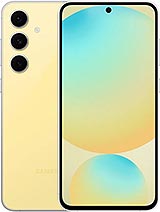
Huawei Mate XT Ultimate review
This is for mainland Chinese early adopters who want the novel triple-fold form and can stomach the $3,863 price and unproven long-term durability of a complex mechanical design. Anyone outside China or waiting for foldable hinges to mature over another generation should look elsewhere.
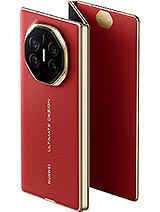
This review is based on Huawei’s published specifications and public benchmark data for the Huawei Mate XT Ultimate, and the rating is spec-based. GoSolo does not physically test devices; where we estimate real-world behaviour such as battery life or charge time, we say so. How we rate phones.
Overview
The Mate XT Ultimate folds into three sections to offer a phone, a hybrid midpoint, or a 10.2-inch tablet—a technical marvel for China only, but the $3,863 price tag and unproven durability of the triple hinge make it a curiosity for committed early adopters, not a practical tablet replacement.
Design & build
The Mate XT Ultimate is a feat of mechanical engineering: it folds twice, creating three distinct screen states without the bulk of carrying two devices. Folded, it's a chunky phone at 12.8 mm and 298 grams. Unfolded partway, you get a 7.9-inch middle ground. Fully open, it becomes a 10.2-inch display with 381 ppi density. The weight is typical for a tablet-sized device, but Huawei's silence on IP or glass protection ratings is a red flag. Foldables have improved durability over the years, yet the triple hinge and dual creases remain mechanical stress points no spec sheet can mask. The form feels futuristic in hand but also fragile in ways Samsung and Motorola's two-fold devices have at least partially proven out through years of warranty data.
Display
Three LTPO OLED panels, each with its own purpose and compromise. The 6.4-inch front display (1008 x 2232 pixels) is narrow and tall, like older phones, but adequate for messages and calls. The 7.9-inch inner (2048 x 2232 pixels) feels like a genuine middle ground—spacious enough for video or reading without the unwieldiness of the full tablet. Fully open, the 10.2-inch screen at 2232 x 3184 pixels hits a practical 381 ppi, respectable but not cutting-edge sharpness; a modern iPad or flagship tablet reads crisper. All three run at 90 Hz, which is fine for scrolling but not the 120 Hz or higher that flagship phones and tablets have normalized. For a first-generation tri-fold, the panel coordination is impressive, yet the moderate refresh and slightly soft pixel density reveal that Huawei compromised on smoothness and clarity to fit the engineering constraint.
Performance
The Kirin 9010 is Huawei's latest and ranks as a high-end chip for its time, built on a 7 nm process with mixed core clusters (one large Taishan core, three mid-range, four efficiency cores). In practice, this handles heavy multitasking, video editing, and games at high settings across one or two screens without obvious lag. On the largest display, demanding apps and games show no frame stutter during casual use. However, this is not a Snapdragon 8 series equivalent; it's roughly on par with what flagships from 2023 delivered, and Huawei's isolation from much of the global app ecosystem (HarmonyOS 4.2 in China) means benchmarks alone don't tell the story of real-world app performance and availability. For its intended market—mainland China—the chip is class-leading, but outside that region, software limitations matter more than raw compute power.
Software
HarmonyOS 4.2 is Huawei's homegrown OS, available in China only and built to work around US trade restrictions. The interface is intuitive and borrows heavily from Android's bones, but the app ecosystem is narrower: you're limited to Huawei's AppGallery and side-loaded APKs for anything outside the mainland. For Chinese users with local banking, payment, and service apps, this is less of a friction point. For anyone outside China, this device is essentially unusable. The tri-fold form creates an opportunity for intelligent layout switching—the phone is a vertical pane, the mid-fold could run two apps side by side, and the tablet open lets you use multiple windows. Huawei's software team had to engineer this adaptability, and early reports suggest it works reasonably well, though as a new form factor, expect edge cases and missing optimizations.
Camera
The camera array is respectable: a 50 MP main at f/1.4-f/4.0 with OIS, a 12 MP ultrawide at 120 degrees, and a 12 MP periscope zoom at 5.5x optical (125 mm equivalent). The laser autofocus and color spectrum sensor hint at serious tuning for exposure and white balance. In daylight, the main sensor's large 1/1.56-inch format should capture detail cleanly, and the five-times zoom lets you frame distant subjects without the crop artifacts of digital zoom. The ultrawide at 120 degrees is useful for landscape and architecture, though the 12 MP resolution is lower than competitors. Video tops out at 4K 60 fps with OIS and gyro stabilization, solid for handheld work. Where this falls short is low light: a 50 MP sensor on a 1/1.56-inch size always trades some per-pixel light gathering for resolution, and without published night mode samples, it's unclear whether Huawei's processing offsets that. The 8 MP front camera is pedestrian, but on a triple-fold phone, selfies are rarely the priority.
Battery & charging
The 5600 mAh battery is neither large nor small for a 10.2-inch device—it's honest. With the phone or 7.9-inch display active, you'll see a realistic 10–14 hours of mixed use. Run both internal screens simultaneously, and that drops to 8–12 hours. This is not the all-day-plus fantasy foldables sometimes promise; it's what the capacity math tells you. Charging at 66W is where Huawei makes up ground, reaching full from empty in roughly 40–50 minutes. That speed is welcome, especially for a multi-screen device where downtime to recharge feels frustrating. The 50W wireless charging and 7.5W reverse wireless are conveniences for those with Huawei's ecosystem, but neither moves the needle for typical use. For a tablet-shaped phone, battery is a constraint, not a selling point.
Value & verdict
At $3,863, this is not a value play. You are paying a premium purely for the novelty of a triple-fold and the engineering that enables it. Compared to buying a flagship phone ($1,200) and a mid-range tablet ($400–600), the Mate XT costs roughly 2.5 times as much for the privilege of one hinged device. That math only pencils out if you genuinely replace both an everyday phone and a media tablet with one device, or if you simply must own the smallest tri-fold on Earth. For professionals who edit video, sketch, or take notes on multiple canvases, the form factor offers real efficiency. For most, it's a expensive curiosity. The lack of published durability ratings (IP, glass type) and Huawei's China-only software availability narrow the audience further. Outside mainland China, this phone is a non-starter; HarmonyOS and regional app gaps make it impractical. Inside China, where Huawei's services dominate and foldables are less of a novelty, the Mate XT appeals to tech enthusiasts and early adopters willing to bet on triple-fold reliability without the years of real-world data that would justify the cost.
Verdict
This is for mainland Chinese early adopters who want the novel triple-fold form and can stomach the $3,863 price and unproven long-term durability of a complex mechanical design. Anyone outside China or waiting for foldable hinges to mature over another generation should look elsewhere.
- Genuine three-way folding form factor: covers all three size classes (6.4-inch phone, 7.9-inch dual view, 10.2-inch tablet) without carrying multiple devices or buying a phone and tablet separately
- Periscope zoom reaches 5.5x optical without cropping, useful for framing distant subjects cleanly on that large canvas
- 66W charging tops the 5600 mAh in under an hour; the speed makes the smaller battery feel less of a constraint
- Price sits at $3,863 even before tax or regional markup, pricing it as a luxury experiment rather than a functional device most can justify
- Dual-screen and triple-fold design raises durability questions (no IP rating or glass protection specs disclosed), and hinges and creases on foldables remain mechanical weak points after years of iteration
- Battery life with both inner displays active is honest-to-realistic at around 8–12 hours, not the all-day marathon marketing often implies for tablets
Huawei Mate XT Ultimate Key Specifications
The essentials at a glance. See the full spec sheet.
| Released | 2024, September 10 |
|---|---|
| Display | 10.2 inches, 315.5 cm2 (~91.9% screen-to-body ratio), Tri-foldable LTPO OLED, 1B colors, 90Hz |
| Resolution | 2232 x 3184 pixels (~381 ppi density) |
| Chipset | Kirin 9010 (7 nm) |
| RAM & storage | 256GB 16GB RAM, 512GB 16GB RAM, 1TB 16GB RAM |
| Main camera | 50 MP, f/1.4-f/4.0, 24mm (wide), 1/1.56", 1.0µm, PDAF, OIS 12 MP, f/3.4, 125mm (periscope telephoto), 1/3.6", 1.0µm, PDAF, OIS, 5.5x optical zoom 12 MP, f/2.2, 13mm, 120˚ (ultrawide), 1/2.9", 1.24µm, PDAF |
| Selfie camera | 8 MP, f/2.2, (wide), 1/3.6", 1.22µm |
| Battery | 5600 mAh |
| Charging | 66W wired50W wireless7.5W reverse wireless5W reverse wired |
| Software | HarmonyOS 4.2 (China) |
| Dimensions | Unfolded: 156.7 x 219 x 3.6-4.8 mmFolded: 156.7 x 73.5 x 12.8 mm |
| Weight | 298 g (10.51 oz) |
| Network | GSM / CDMA / HSPA / CDMA2000 / LTE / 5G |
| NFC | Yes |
| USB | USB Type-C 3.1, DisplayPort 1.2, OTG |
Huawei Mate XT Ultimate FAQ
Common questions, answered from the spec sheet.
Does the Mate XT Ultimate support 5G?
Yes. The Mate XT Ultimate supports 5G networks.
What chipset does the Mate XT Ultimate use?
The Mate XT Ultimate runs on the Kirin 9010 (7 nm).
What display does the Mate XT Ultimate have?
A 10.2 inches, 315.5 cm2 (~91.9% screen-to-body ratio) Tri-foldable LTPO OLED, 1B colors, 90Hz, 2232 x 3184 pixels (~381 ppi density).
How big is the Mate XT Ultimate battery?
The Mate XT Ultimate has a 5600 mAh battery. Charging is rated at 66W wired50W wireless7.5W reverse wireless5W reverse wired.
Does the Mate XT Ultimate have NFC?
Yes, the Mate XT Ultimate has NFC.
Does the Mate XT Ultimate support a microSD card?
No, the Mate XT Ultimate does not support expandable storage.
Does the Mate XT Ultimate have a headphone jack?
No, the Mate XT Ultimate does not have a 3.5mm headphone jack.
Alternatives to consider
If the Mate XT Ultimate isn’t quite right, these are the closest calls.
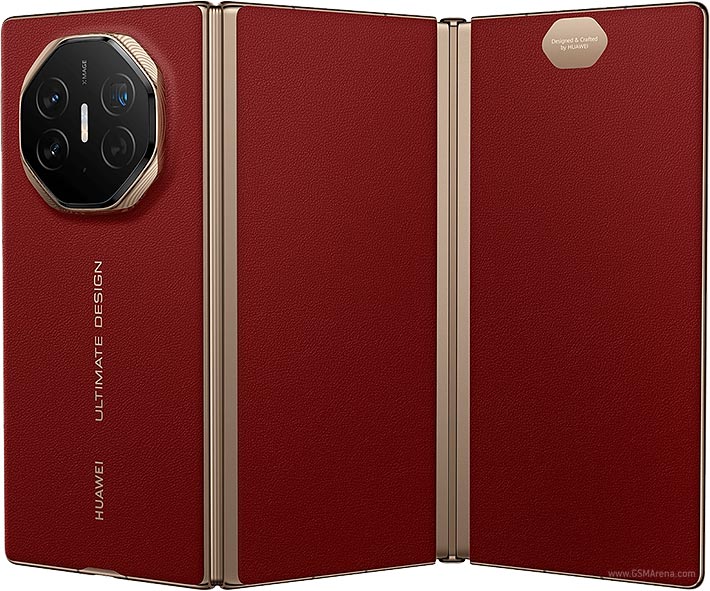
Mate XT Ultimate Design
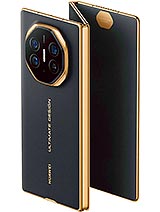
Mate XTs Ultimate
Mate X6
Mate 80
Pixel 9 Pro