Infinix Hot 30 review
The Hot 30 suits someone who browses, chats, watches video, and plays light games but has no interest in gaming seriously, taking phone photography as a hobby, or charging in a rush. If you need a phone that lasts all day without stress and can handle expandable storage without losing a SIM slot, it delivers. Anyone chasing gaming performance, fast charging, or modern camera versatility should look elsewhere.
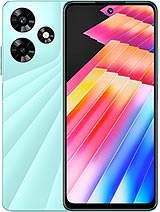
This review is based on Infinix’s published specifications and public benchmark data for the Infinix Hot 30, and the rating is spec-based. GoSolo does not physically test devices; where we estimate real-world behaviour such as battery life or charge time, we say so. How we rate phones.
Overview
The Hot 30 is a large, long-lasting everyday phone that nails the basics—a 6.78-inch 90Hz display, 5000mAh battery, headphone jack, and expandable storage—without pretending to be more than it is. The Helio G88 and 50MP camera are competent but won't impress anyone expecting performance or image quality to punch above its price tier.
Design & build
At 196g and 8.4mm thick, the Hot 30 sits comfortably in one hand without feeling heavy or bloated. Glass front with plastic frame and back keeps it light enough that it won't exhaust your palm after a day of use, though the plastic back feels less refined than metal. The side-mounted fingerprint sensor is reachable and responsive. Build quality is solid for the price, though it's not a phone that makes you forget its cost.
Display
The 6.78-inch 1080p IPS panel is the Hot 30's strongest selling point. 90Hz refresh makes scrolling through apps and feeds feel smooth, a step above 60Hz devices that still dominate this price bracket. Peak brightness of 600 nits handles sunlight adequately, though it doesn't match AMOLED flagships that hit 1500+ nits. At 396ppi the pixel density is sharp enough for everyday viewing. The large screen real estate wins the day for anyone who reads, watches video, or browses for hours.
Performance
The Helio G88 is a 2021-era budget processor that handles everyday tasks—messaging, social media, light browsing—without strain. With 4GB or 8GB RAM options, the phone stays snappy in typical use. The Mali-G52 GPU stumbles when you push it: casual games run fine, but demanding titles like Genshin Impact or high-setting Fortnite will drop frames and stutter. If you plan to game seriously, this chipset will frustrate you. For office work, chat apps, and casual play, it's fit for purpose.
Software
Android 13 with Infinix's XOS 12.6 skin sits in the middle ground. XOS adds customization and some bloat, but it's not invasive enough to ruin the experience. Updates are historically slower from Infinix than from Samsung or OnePlus at comparable prices, so don't expect security patches or major OS bumps quickly. For a 2023 device, the software stack is dated by mid-2026 standards, and there's little reason to expect Android 14 or 15 to arrive soon.
Camera
The 50MP f/1.6 main sensor captures good daylight photos with solid detail and color. The large aperture helps in low light, though the small 1/2.55-inch sensor can't compete with flagship cameras when you crop or zoom in. Night mode works but introduces visible noise. The 8MP selfie handles video calls without embarrassment but lacks the resolution or features (ultra-wide, macro) that some budget rivals now offer. This is a camera that will disappoint anyone expecting flagship-class image quality or versatility.
Battery & charging
The 5000mAh battery is the real stamina player. Light to moderate use nets a full day easily, often into evening or the next morning. Video, maps, and games burn faster, but even heavy days seldom end with a dead phone. The 33W charging is a sore point: it takes roughly 50 to 60 minutes from zero to full, adequate for a quick top-up but slow compared to the 65W, 100W, and even 120W charging now standard in its price tier. If you charge overnight, it's fine; if you need a 15-minute boost to full, you'll wait.
Value & verdict
By mid-2026, the Hot 30 is a 2023-era device at a price that reflects that age. The large display, all-day battery, headphone jack, and expandable storage appeal to users who value practicality over prestige. The lack of 5G is a non-issue in most global-south markets where LTE remains the norm, and Wi-Fi ac with NFC covers the connectivity gaps for payments and file transfer. Where it stumbles is performance, charging speed, and camera versatility—areas where newer budget phones at the same price have caught up and moved ahead.
Verdict
The Hot 30 suits someone who browses, chats, watches video, and plays light games but has no interest in gaming seriously, taking phone photography as a hobby, or charging in a rush. If you need a phone that lasts all day without stress and can handle expandable storage without losing a SIM slot, it delivers. Anyone chasing gaming performance, fast charging, or modern camera versatility should look elsewhere.
- 5000mAh battery comfortably lasts a full day of mixed use, with breathing room for heavier days
- 6.78-inch 90Hz IPS display is genuinely large and fluid for reading, browsing, and video without feeling cramped
- Dedicated microSDXC slot means you can expand storage without losing a SIM card slot, practical for media and apps
- Keeps the 3.5mm headphone jack and stereo speakers, rare enough now to matter if you use wired audio or rely on speaker output
- Helio G88 and Mali-G52 GPU stumble on demanding games; anything beyond light titles or modest graphics will stutter
- 33W charging takes roughly 50 minutes to full capacity, slower than rivals at this price that now routinely hit 65W or higher
- 1/2.55-inch sensor limits detail and low-light performance relative to 50MP flagship shooters, results soften on closer inspection
Infinix Hot 30 Key Specifications
The essentials at a glance. See the full spec sheet.
| Released | 2023, March 31 |
|---|---|
| Display | 6.78 inches, 109.2 cm2 (~84.5% screen-to-body ratio), IPS LCD, 90Hz, 500 nits (typ), 600 nits (peak) |
| Resolution | 1080 x 2460 pixels (~396 ppi density) |
| Chipset | Mediatek MT6769H Helio G88 (12 nm) |
| RAM & storage | 128GB 4GB RAM, 128GB 8GB RAM, 256GB 8GB RAM |
| Main camera | 50 MP, f/1.6, (wide), 1/2.55", AF Auxiliary lens |
| Selfie camera | 8 MP, f/2.5, (wide) |
| Battery | 5000 mAh |
| Charging | 33W wired, 55% in 30 min |
| Software | Android 13, XOS 12.6 |
| Dimensions | 168.7 x 76.6 x 8.4 mm (6.64 x 3.02 x 0.33 in) |
| Weight | 196 g (6.91 oz) |
| Build | Glass front, plastic frame, plastic back |
| Network | GSM / HSPA / LTE |
| NFC | Yes |
| USB | USB Type-C 2.0, OTG |
Infinix Hot 30 FAQ
Common questions, answered from the spec sheet.
Does the Hot 30 support 5G?
No. The Hot 30 tops out at GSM / HSPA / LTE, without 5G.
What chipset does the Hot 30 use?
The Hot 30 runs on the Mediatek MT6769H Helio G88 (12 nm).
What display does the Hot 30 have?
A 6.78 inches, 109.2 cm2 (~84.5% screen-to-body ratio) IPS LCD, 90Hz, 500 nits (typ), 600 nits (peak), 1080 x 2460 pixels (~396 ppi density).
How big is the Hot 30 battery?
The Hot 30 has a 5000 mAh battery. Charging is rated at 33W wired, 55% in 30 min.
Does the Hot 30 have NFC?
Yes, the Hot 30 has NFC.
Does the Hot 30 support a microSD card?
Yes, the Hot 30 supports expandable storage (microSDXC (dedicated slot)).
Does the Hot 30 have a headphone jack?
Yes, the Hot 30 has a 3.5mm headphone jack.
Alternatives to consider
If the Hot 30 isn’t quite right, these are the closest calls.
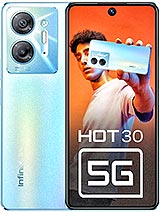
Hot 30 5G
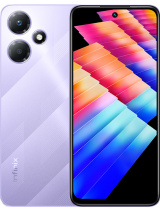
Hot 30 Play NFC
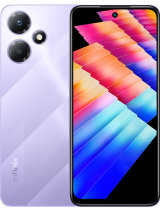
Hot 30 Play

Hot 40
Galaxy A06