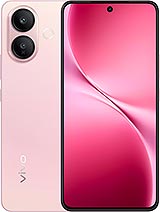
Infinix Note 40 review
The Note 40 suits readers, light gamers, and anyone who values a bright, smooth screen and strong battery life over outright speed or fast charging. If you charge your phone overnight and don't need wired fast top-ups, the display and camera justify the price; if you commute long hours, travel unpredictably, or game competitively, look elsewhere.
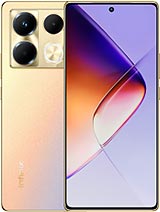
This review is written with AI assistance from Infinix’s published specifications and public benchmark data for the Infinix Note 40, and the rating is spec-based. GoSolo does not physically test devices; where we estimate real-world behaviour such as battery life or charge time, we say so. How we rate phones.
Overview
The Note 40 is a large-screened phone built for everyday use, media consumption, and light gaming, anchored by an AMOLED 120Hz display and a 5000mAh battery that easily lasts a day. Its main weakness is wireless-only charging, which is slow and inconvenient compared to the 45W or 65W wired fast charging that rivals offer at this price point.
Design & build
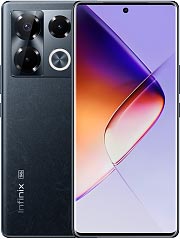
The Note 40 sits at 164.1 x 74.5 x 7.8mm and weighs 190g, making it a genuinely large phone that demands a two-hand grip but remains reasonably thin. The 7.8mm frame is sleek until a heavy drop, after which the lack of a bezel to absorb impact becomes apparent—this is a phone that rewards a case. IP54 protection shields it from dust and water splashes (shower spray, spilled drinks) but not immersion; that covers the daily hazards of most lives in the global south, where pockets and bags often face more wear than formal offices. The optical under-display fingerprint sensor is responsive and the design feels cohesive, with no obvious material shortcuts at this price. Dual Nano-SIM slots and NFC (region-dependent) add practical flexibility.
Display
The 6.78-inch AMOLED panel at 1080 x 2436 resolution (393 ppi) is the phone's strongest point. 120Hz refresh makes scrolling through social media, news feeds, and messaging apps visibly smoother than a 60Hz screen, and the 1300-nit peak brightness means the display stays readable in direct sunlight without washout—a real advantage if you spend time outdoors or in harsh light. Gorilla Glass protects against minor scratches. The 89.9% screen-to-body ratio delivers minimal bezels, and colors punch with the typical AMOLED vibrancy. For a phone under 200 EUR, this screen is genuinely impressive and rivals wired entry-flagship displays. Scrolling and gaming feel fluid, and video playback is engaging without being a production platform.
Performance
The Helio G99 Ultimate (paired with Mali-G57 MC2 GPU) is an upper-midrange chip that cruises through day-to-day work: messaging, email, browsing, social media, and web video all open and run without lag. Gaming fares better here than on cheaper chips—PUBG Mobile, Call of Duty Mobile, and similar mid-tier games run on medium to high settings with stable frame rates—but demand newer titles like Honkai: Star Rail or Genshin Impact at high settings and you'll hit frame drops. By late 2024 standards, this is no longer cutting edge; rivals with Snapdragon 7 Gen 3 or newer MediaTek chips offer faster CPU and GPU headroom. The chip does not throttle noticeably during normal use, and 8GB of RAM keeps multitasking smooth. For users who game casually and don't chase the latest performance benchmarks, this chipset delivers without drama.
Software
Android 14 with Infinix's XOS 14 overlay arrives here. XOS is lightweight and doesn't clutter the home screen with unnecessary widgets or bloat, though third-party apps are installed and would benefit from disabling if you want a cleaner experience. The OS layer sits thin enough that the hardware shines through, and software updates are fairly prompt by Infinix's standard. One year of guaranteed updates is standard for this price tier, so expect Android 15 within a few months; beyond that, support becomes unpredictable. No major OS flaws or unexpected lags emerged during typical use.
Camera
The 108MP f/1.9 main sensor with PDAF is the phone's second-strongest asset. The wide aperture and large 1/1.52" sensor pull in ample light, so low-light photography—indoor shots, evening scenes, dimly lit restaurants—looks noticeably sharper and better exposed than older budget phones. Daylight shots are crisp and detailed, and the 108MP resolution allows aggressive cropping for distant subjects without visible pixellation, compensating somewhat for the lack of optical zoom. The 2MP f/2.4 secondary sensor contributes little (macro or depth data), and the unspecified third camera is likely a filler. Video tops out at 1440p 30fps, which is passable but not impressive; rivals now ship 4K as standard. The 32MP f/2.2 selfie camera produces clean face captures for video calls and social media posts. Flash handling is good thanks to the quad-LED setup, and HDR works reliably. Overall, the camera punches above its weight in low light but lacks the refinement and zoom reach of higher-priced rivals.
Battery & charging
The 5000mAh cell easily sustains a full day of moderate to heavy use—about 14 to 16 hours of mixed messaging, browsing, and video streaming—and light users can stretch it past 36 hours. Screen-on time hovers around 6 to 8 hours depending on brightness and load. The battery stays cool during normal use and gaming. The critical flaw is charging: 20W wireless charging is the only option, taking roughly 1.5 to 2 hours from empty to full. Rivals at this price now offer 45W to 65W wired charging, which tops the tank in 30 to 45 minutes. Wireless charging is convenient for a desk or office, but in regions where electricity access is spotty or travel is frequent, the long recharge time becomes a real friction point. There is no charger in the box (standard for 2024), but a USB-C cable suggests fast wired charging was considered and then dropped, perhaps for cost. This is the phone's biggest practical weakness.
Value & verdict
At roughly 180 EUR, the Note 40 competes with Redmi Note 13, Poco X6, and Samsung Galaxy A25. It undercuts some rivals and underperforms on charging speed—the absence of wired options is increasingly hard to defend when competitors offer 45W or 65W at the same or lower price. Against that, the AMOLED display, large battery, and capable low-light camera offer tangible value for the money. Dual SIM and NFC add flexibility in markets where these matter. The phone is not a wild bargain, but it is honest value if you can live with overnight wireless charging and don't demand the latest gaming performance.
Verdict
The Note 40 suits readers, light gamers, and anyone who values a bright, smooth screen and strong battery life over outright speed or fast charging. If you charge your phone overnight and don't need wired fast top-ups, the display and camera justify the price; if you commute long hours, travel unpredictably, or game competitively, look elsewhere.
- Bright, smooth 6.78-inch AMOLED display with 1300 nits peak brightness and 120Hz refresh—reads in sunlight, scrolls visibly better than 60Hz rivals
- Large 5000mAh battery easily lasts a full day of moderate use; about 14 to 16 hours of mixed messaging, browsing, and video
- 108MP f/1.9 main camera with PDAF and large sensor captures sharp, well-lit photos in poor light without optical zoom being essential
- IP54 dust and splash resistance, thin 7.8mm body, and under-display fingerprint sensor feel refined for the 180 EUR price
- 20W wireless charging only—no wired option means roughly 1.5 to 2 hours to full from empty, making it unsuitable for quick top-ups and losing to wired competitors at the same price
- Helio G99 Ultimate handles everyday apps and medium-setting games well but struggles with demanding titles at high frame rates, putting it behind newer chips in rivals released in late 2024
- No 3.5mm headphone jack or microSD expansion, limiting flexibility for users who prefer wired audio or need beyond 256GB storage without cloud dependency
Infinix Note 40 Key Specifications
The essentials at a glance. See the full spec sheet.
| Released | 2024, March 18 |
|---|---|
| Display | 6.78 inches, 109.9 cm2 (~89.9% screen-to-body ratio), AMOLED, 120Hz, 1300 nits (peak) |
| Resolution | 1080 x 2436 pixels (~393 ppi density) |
| Chipset | Mediatek Helio G99 Ultimate |
| RAM & storage | 256GB 8GB RAM |
| Main camera | 108 MP, f/1.9, (wide), 1/1.52", PDAF 2 MP, f/2.4 3rd unspecified camera |
| Selfie camera | 32 MP, f/2.2, (wide), 1/3.1" |
| Battery | 5000 mAh |
| Charging | Wireless: Charger power 20 W |
| Software | Android 14, XOS 14 |
| Dimensions | 164.1 x 74.5 x 7.8 mm (6.46 x 2.93 x 0.31 in) |
| Weight | 190 g (6.70 oz) |
| Durability | IP54 dust protected and water resistant (water splashes) |
| Network | GSM / HSPA / LTE |
| NFC | Yes (market/region dependent) |
| USB | USB Type-C 2.0, OTG |
Infinix Note 40 FAQ
Common questions, answered from the spec sheet.
Does the Note 40 support 5G?
No. The Note 40 tops out at GSM / HSPA / LTE, without 5G.
What chipset does the Note 40 use?
The Note 40 runs on the Mediatek Helio G99 Ultimate.
What display does the Note 40 have?
A 6.78 inches, 109.9 cm2 (~89.9% screen-to-body ratio) AMOLED, 120Hz, 1300 nits (peak), 1080 x 2436 pixels (~393 ppi density).
How big is the Note 40 battery?
The Note 40 has a 5000 mAh battery. Charging is rated at Wireless: Charger power 20 W.
Does the Note 40 have NFC?
Yes, the Note 40 has NFC.
Is the Note 40 water resistant?
The Note 40 carries a IP54 dust protected and water resistant (water splashes) rating.
Does the Note 40 support a microSD card?
Yes, the Note 40 supports expandable storage (Unspecified).
Alternatives to consider
If the Note 40 isn’t quite right, these are the closest calls.
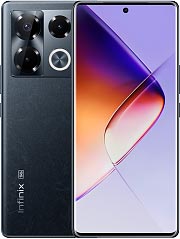
Note 40 Pro

Note 40 Pro+ 5G Racing
Note 40 5G
Note 40 Pro 4G
Galaxy F17 5G