Lava Blaze Dragon review
The Blaze Dragon suits someone who needs a large, long-lasting phone for casual use and does not game or shoot photos often. Anyone who uses their phone hard, demands fast charging, or wants a capable camera should look at faster competitors in the same price tier.
This review is written with AI assistance from Lava’s published specifications and public benchmark data for the Lava Blaze Dragon, and the rating is spec-based. GoSolo does not physically test devices; where we estimate real-world behaviour such as battery life or charge time, we say so. How we rate phones.
Overview
The Lava Blaze Dragon trades camera and charging speed for a large screen, 5G, and a capacious battery at about €100. It is a competent daily driver for messaging and video, but the Snapdragon 4 Gen 2 and 18W charging are measurably behind what rivals now offer in this price tier.
Design & build
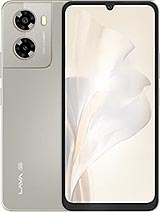
At 210 g and 9.1 mm, the Blaze Dragon is slim and light for its screen size—a real practical win. The IP64 rating handles dust and splashes from any angle, stopping short of full submersion; adequate for everyday life but not rugged enough for beach trips or serious water exposure. The design is unremarkable: no premium materials mentioned, just a straightforward slab that prioritizes thinness over grip or distinctiveness. Build quality at this price is usually functional rather than refined, and nothing in the spec sheet suggests Lava breaks that pattern. The side-mounted fingerprint sensor is a practical choice for a phone this wide.
Display
The 6.75-inch LCD is the phone's strongest story. At 260 ppi, pixels are invisible to the eye; 120Hz refresh keeps scrolling and swiping smooth, a feature that moved downmarket fast and now separates pleasant from draggy screens at budget prices. The 450-nit brightness is adequate indoors and overcast daylight but will wash out under direct sun—typical for a budget LCD, less forgiving than OLED. The 16:9 aspect ratio and high screen-to-body ratio (105%) maximize usable space without pushing the phone into awkward dimensions. For the price, this is one of the phone's few unambiguous strengths: you get a large, responsive display without buying a flagship.
Performance
The Snapdragon 4 Gen 2 is entry-level silicon, and 2025 has proven that does not age well in real-world feel. The octa-core CPU—two fast cores and six efficiency cores—handles messaging, social media, YouTube, and light browsing without lag. Multitasking works, but app switching is slower than phones with Snapdragon 6 or 7 series chips, which are standard at this price now. Gaming lands in the playable zone only if you accept medium settings and 30 fps on popular titles like PUBG Mobile; demanding games will stutter. For a first phone or a backup device, it suffices. As your main phone, the cracks show within weeks of everyday use.
Software
Android 15 is current and clean. The update promise—one major Android upgrade—is honest but minimal: you get Android 16, then you are on your own. For budget phones, this is par; flagships promise five or more years of updates. No bloat is mentioned, suggesting Lava kept the software lean, which counts in a phone with 4 GB base RAM. Expect decent security patches in the first 18 months; thereafter, they may dry up.
Camera
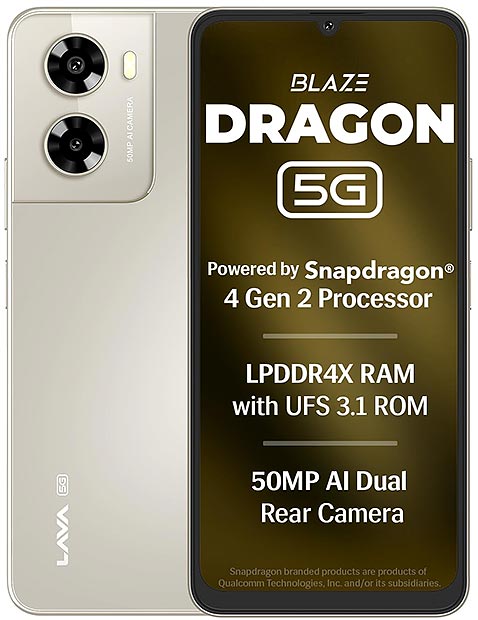
The 50 MP main sensor captures sharp daytime photos in good light, but the package is bare. No ultrawide, no zoom lens, no macro mode—just the one wide camera. The 2 MP second sensor is likely depth-assist, not a second shooter. The lack of a dedicated night mode means low-light shots will be soft and noisy; the lack of 4K forces you to crop from 1080p for distant subjects, losing detail fast. The 8 MP selfie is adequate for video calls and casual shots. At this price, you do not expect a camera to compete with flagships, but it underperforms even mid-range rivals, which offer an ultrawide and 4K at the same or lower cost. The camera defines the phone's biggest compromise: it will frustrate anyone who shoots photos regularly.
Battery & charging
The 5000 mAh cell is the standout: on mixed use (social media, messaging, some video), you will get 8–10 hours of screen-on time before evening top-up. Heavy users may push harder and drain faster, but the capacity buys margin most rivals lack. Charging, however, is a slow point. 18W is standard for budget phones five years ago; today, €70–100 rivals hit 33–65W, and you can recharge in 30 minutes instead of 60–90. The long cable time is a real friction in 2025, especially if you share a charger or forget to plug in overnight. For a secondary phone or light user, the battery size compensates; for anyone charging on a tight schedule, this stings.
Value & verdict
At about €100, the Blaze Dragon is affordable by any measure. The large, smooth screen, 5G, and genuine all-day battery are selling points that matter for the price. Against that, the Snapdragon 4 Gen 2 is now noticeably slower than chips that cost the same, the camera is stripped down even by budget standards, and 18W charging is a visible disadvantage. Rivals in the same price range—often from Xiaomi, Realme, or even Lava's own portfolio—offer faster chips, better cameras, or faster charging. The Blaze Dragon works if you value screen size and battery life above all else, or if it is your second phone. For a main device, it requires patience with performance and a willingness to live with a basic camera.
Verdict
The Blaze Dragon suits someone who needs a large, long-lasting phone for casual use and does not game or shoot photos often. Anyone who uses their phone hard, demands fast charging, or wants a capable camera should look at faster competitors in the same price tier.
- Genuine all-day battery: 5000 mAh and modest power draw mean you can run through a mixed day without panic, more than most at this price.
- Spacious, smooth display: 6.75 inches with 120Hz makes scrolling and video feel fluid, and the size is real estate you do not get on €100 rivals.
- 5G and dual SIM: covers future-proofing without the usual premium markup, useful if your region has 5G rollout.
- Thin and light: at 9.1 mm and 210 g, it slips into a pocket without weight or bulk, a rarity for a 6.75-inch phone.
- 18W charging is now a handicap: rivals in this price band hit 33–65W; a full recharge takes roughly 60–90 minutes versus 20–30 for faster competitors.
- Entry-level chipset: Snapdragon 4 Gen 2 handles everyday tasks but struggles with demanding games and heavy multitasking, and will feel slower in day-to-day app opening by 2026 standards.
- Camera is bare-bones: 50MP main shot only, no ultrawide, no 4K video, and no night mode means crops for zoom and soft low-light shots.
Lava Blaze Dragon Key Specifications
The essentials at a glance. See the full spec sheet.
| Released | 2025, July 25 |
|---|---|
| Display | 6.75 inches, 137.5 cm2 (~105.0% screen-to-body ratio), LCD, 120Hz, 450 nits |
| Resolution | 900 x 1600 pixels, 16:9 ratio (~260 ppi density) |
| Chipset | Qualcomm SM4450 Snapdragon 4 Gen 2 (4 nm) |
| RAM & storage | 128GB 4GB RAM, 128GB 6GB RAM |
| Main camera | 50 MP, (wide), 1/2.8" 2 MP |
| Selfie camera | 8 MP |
| Battery | 5000 mAh |
| Charging | 18W wired |
| Software | Android 15, up to 1 major Android upgrade |
| Dimensions | 168.2 x 77.8 x 9.1 mm (6.62 x 3.06 x 0.36 in) |
| Weight | 210 g (7.41 oz) |
| Durability | IP64 dust tight and water resistant (water splashes) |
| Network | GSM / HSPA / LTE / 5G |
| NFC | No |
| USB | USB Type-C 2.0, OTG |
Lava Blaze Dragon FAQ
Common questions, answered from the spec sheet.
Does the Blaze Dragon support 5G?
Yes. The Blaze Dragon supports 5G networks.
What chipset does the Blaze Dragon use?
The Blaze Dragon runs on the Qualcomm SM4450 Snapdragon 4 Gen 2 (4 nm).
What display does the Blaze Dragon have?
A 6.75 inches, 137.5 cm2 (~105.0% screen-to-body ratio) LCD, 120Hz, 450 nits, 900 x 1600 pixels, 16:9 ratio (~260 ppi density).
How big is the Blaze Dragon battery?
The Blaze Dragon has a 5000 mAh battery. Charging is rated at 18W wired.
Does the Blaze Dragon have NFC?
No, the Blaze Dragon does not list NFC support.
Is the Blaze Dragon water resistant?
The Blaze Dragon carries a IP64 dust tight and water resistant (water splashes) rating.
Does the Blaze Dragon support a microSD card?
Yes, the Blaze Dragon supports expandable storage (microSDXC (uses shared SIM slot)).
Does the Blaze Dragon have a headphone jack?
Yes, the Blaze Dragon has a 3.5mm headphone jack.
Alternatives to consider
If the Blaze Dragon isn’t quite right, these are the closest calls.
Lava Blaze Dragon 5G
Yuva 2 5G
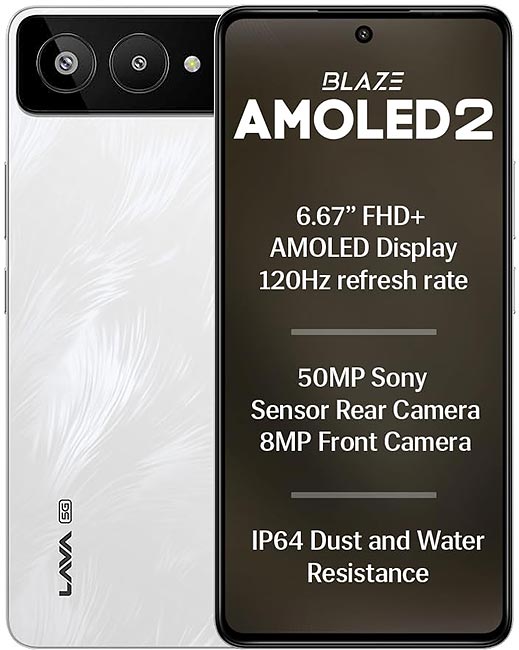
Blaze Amoled
Shark 4G
Galaxy M17e