Motorola Moto G Play 2026 review
This phone suits users in 5G-ready regions who value long battery life, room to expand storage, and dual SIM switching over screen sharpness and speed. Anyone expecting sharp text on a 6.7-inch display, snappy gaming, or a quick charge should look at competitors in the $180–$200 range, where screen resolution and charging power improve noticeably.
This review is based on Motorola’s published specifications and public benchmark data for the Motorola Moto G Play 2026, and the rating is spec-based. GoSolo does not physically test devices; where we estimate real-world behaviour such as battery life or charge time, we say so. How we rate phones.
Overview
The Moto G Play 2026 is a straightforward budget phone with 5G, expandable storage, and a 6.7-inch 120Hz screen held back by 720p resolution and a low-powered chipset. It suits people who prioritize battery longevity, dual SIM, and room to expand storage over screen sharpness and speed, but the 18W charging and weak performance cap its appeal even in the budget tier.
Design & build
At 202 grams and 8.5 mm thick, the G Play sits in the comfortable middle ground for a 6.7-incher—not bloated, but with some heft. The eco leather back and plastic frame keep costs down, though the glass front with Gorilla Glass 3 is a standard touch at this price. Water-repellent design means it can handle light splashes, which matters more than an IP rating in real use. The phone feels sturdy enough for daily grip, though this is not a phone that screams durability or feels particularly premium.
Display
The 6.7-inch IPS LCD with 120Hz refresh is where Motorola tried to punch above its price point, and it partly succeeds. Scrolling feels fluid, and 1000 nits peak brightness handles sunlight decently. The problem is pixel density: at 262 ppi, the 720p resolution becomes obvious next to any 1080p phone at similar size. Text is legible but noticeably softer, and sharp photo detail takes a hit. For the money, this is still a reasonable display for messaging, video, and casual browsing, but anyone switching from a mid-ranger with 1080p will notice the drop immediately.
Performance
The Dimensity 6300 is a mainstream entry-level chip for 2025. Apps open without lag, multitasking stays smooth for light users, and everyday tasks like messaging and social media pose no problem. Gaming is where it falters: casual puzzle and strategy titles run fine, but anything demanding—3D shooters, high-fidelity action games—will force you to lower settings or accept frame drops. For a person who buys one phone and uses it for three years, this chip is adequate for today but will feel dated by 2027 or 2028. Compared to rivals at $150–$170, the Dimensity 6300 is in the right ballpark, though some competitors ship with slightly faster midrange options.
Software
Android 16 arrives out of the box, and Motorola's near-stock implementation means no bloatware burden. Updates on the budget tier are always a question mark, but Motorola typically commits to two OS updates and three years of security patches for G-series phones. That is not aggressive by flagship standards, but it is respectable for the price. The side-mounted fingerprint sensor works reliably.
Camera
The 32 MP main sensor is a decent specification that does not always translate to real-world results. In daylight, shots are bright and colors are reasonably accurate, but the f/2.2 aperture and small 0.64 µm pixels mean low-light photos lack detail and noise creeps in quickly. PDAF helps with focusing, yet there is no optical stabilization, so handheld video at 1080p@30fps can feel shaky. The 8 MP selfie camera is fine for video calls and casual shots. This is a functional camera suite for a budget phone—good enough for Instagram, not designed for printing.
Battery & charging
The 5200 mAh battery delivers about a day on light use (email, messaging, some browsing), which is solid for the capacity. Heavy multitasking or video streaming will burn it down by evening. The real friction is charging: 18W TurboPower means a full charge takes roughly 90 to 120 minutes from empty. You cannot quickly top up in 30 minutes and leave, which is a real annoyance if you forgot to plug in overnight. By 2026 standards, 18W is slow—rivals at this price now typically offer 30W or higher. This is the trade-off for keeping the phone thin and light.
Value & verdict-context
At $156, the Moto G Play 2026 is priced for shoppers who value expandable storage, 5G readiness, and battery endurance over display crispness and charging speed. In regions with mature 5G coverage, the connectivity future-proofs it against the next couple of OS cycles. The dedicated microSD slot is increasingly rare and genuinely useful at 64GB base storage. The 720p display and slow charging are honest trade-offs, not oversights, and Motorola has sized the battery to absorb the performance bottleneck. Compare it to any direct rival at the same price: you will find phones with sharper screens or faster chips, but few offer this combination of 5G, expandable storage, and all-day battery without cutting corners elsewhere.
Verdict
This phone suits users in 5G-ready regions who value long battery life, room to expand storage, and dual SIM switching over screen sharpness and speed. Anyone expecting sharp text on a 6.7-inch display, snappy gaming, or a quick charge should look at competitors in the $180–$200 range, where screen resolution and charging power improve noticeably.
- 5G connectivity and dual SIM (nano + eSIM) for switching carriers without a second phone
- Dedicated microSD slot expands storage cheaply, crucial at 64GB base
- All-day battery life on light use thanks to the 5200 mAh cell and modest display
- 120Hz IPS display feels smooth to scroll despite low resolution
- 720p resolution on a 6.7-inch screen (262 ppi) leaves text and icons noticeably softer than 1080p rivals in this price range
- 18W charging takes roughly 90 to 120 minutes, unable to add meaningful charge in under an hour
- Mediatek Dimensity 6300 handles everyday apps but struggles with heavy multitasking and any 3D gaming beyond casual titles
Motorola Moto G Play 2026 Key Specifications
The essentials at a glance. See the full spec sheet.
| Released | 2025, November 05 |
|---|---|
| Display | 6.7 inches, 108.2 cm2 (~84.7% screen-to-body ratio), IPS LCD, 120Hz, 1000 nits (peak) |
| Resolution | 720 x 1604 pixels, 20:9 ratio (~262 ppi density) |
| Chipset | Mediatek Dimensity 6300 (6 nm) |
| RAM & storage | 64GB 4GB RAM |
| Main camera | 32 MP, f/2.2, (wide), 0.64µm, PDAF |
| Selfie camera | 8 MP, f/2.0, (wide) |
| Battery | 5200 mAh |
| Charging | TurboPower up to 18 W |
| Software | Android 16 |
| Dimensions | 167.2 x 76.4 x 8.5 mm (6.58 x 3.01 x 0.33 in) |
| Weight | 202 g (7.13 oz) |
| Build | Glass front (Gorilla Glass 3), silicone polymer (eco leather) back, plastic frame |
| Durability | Water-repellent design |
| Network | GSM / HSPA / LTE / 5G |
| NFC | Yes |
| USB | USB Type-C 2.0 |
Motorola Moto G Play 2026 FAQ
Common questions, answered from the spec sheet.
Does the Moto G Play 2026 support 5G?
Yes. The Moto G Play 2026 supports 5G networks.
What chipset does the Moto G Play 2026 use?
The Moto G Play 2026 runs on the Mediatek Dimensity 6300 (6 nm).
What display does the Moto G Play 2026 have?
A 6.7 inches, 108.2 cm2 (~84.7% screen-to-body ratio) IPS LCD, 120Hz, 1000 nits (peak), 720 x 1604 pixels, 20:9 ratio (~262 ppi density).
How big is the Moto G Play 2026 battery?
The Moto G Play 2026 has a 5200 mAh battery. Charging is rated at TurboPower up to 18 W.
Does the Moto G Play 2026 have NFC?
Yes, the Moto G Play 2026 has NFC.
Is the Moto G Play 2026 water resistant?
The Moto G Play 2026 carries a Water-repellent design rating.
Does the Moto G Play 2026 support a microSD card?
Yes, the Moto G Play 2026 supports expandable storage (microSDXC (dedicated slot)).
Alternatives to consider
If the Moto G Play 2026 isn’t quite right, these are the closest calls.
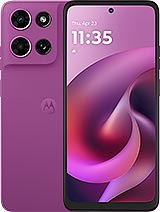
Moto G 2026
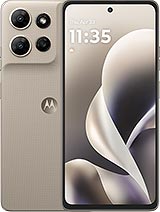
Moto G Power 2026
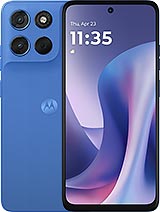
Moto G57
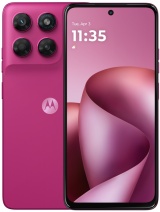
Moto G47
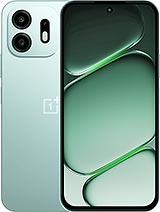
N6