Motorola RAZR review
This is a foldable for people who want a foldable, not for people looking to justify buying one. If a practical outer screen and genuine pocket ergonomics appeal to you, and you can live with a workaday camera and a modest battery, the RAZR 70+ delivers a coherent device. Everyone else should weigh a traditional flagship, which will offer better zoom, longer battery, and faster charging for the same money.
This review is written with AI assistance from Motorola’s published specifications and public benchmark data for the Motorola RAZR, and the rating is spec-based. GoSolo does not physically test devices; where we estimate real-world behaviour such as battery life or charge time, we say so. How we rate phones.
Overview
The Motorola RAZR 70+ is a foldable with genuine ergonomic charm and a practical outer screen, powered by a capable flagship-class chipset and backed by a display that actually demands use. It feels like a real phone that folds, not a technical flex—but the camera system is workmanlike, not compelling, and the price tags lean toward the premium without delivering that tier's camera polish.
Design & build
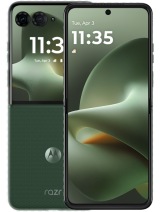
The RAZR 70+ is light at 189g and folds to a thickness of 15.3mm, which is genuinely compact compared to the brick-thick rivals from Samsung and other folding flagships. The outer display being a full 4-inch 165Hz AMOLED screen—not a 3-inch strip—is the real difference here. You can actually reply to messages, scroll feeds, and catch notifications without unfolding. The titanium hinge and Gorilla Glass Victus on the foldable front suggest durability, though Mohs level 4 protection on the inner screen is softer than ideal. Build materials mix plastic on the unfolded front with glass on the folded face, a cost-saving move that keeps weight down but feels like a slight compromise at this price.
Display
The 6.9-inch inner LTPO AMOLED unfolded is bright at 3000 nits peak, with HDR10+ and Dolby Vision support. Resolution is 1084 x 2640 at 414 ppi, which is pixel-dense enough on a foldable. The 165Hz refresh rate makes scrolling snappy. The kicker is the outer 4-inch screen: 1272 x 1080, 417 ppi, 165Hz, 2400 nits peak. It's not just a notch or a hole—it's a usable interface. For a foldable, this is thoughtful: most users won't have to unfold the phone for quick interactions, which is the whole reason foldables exist. Both screens are LTPO, so frame rate scales intelligently.
Performance
The Snapdragon 8s Gen 3 is a high-end chip positioned just below the full-fat flagship tier, and it shows. AnTuTu posts 756k (v10) to 998k (v11), which translates to smooth gaming, lag-free multitasking, and fast app launches. Unlike some maxed-out flagship processors, the 8s runs cooler under sustained load—useful on a foldable where thermal headroom is tighter. Android 16 is current, and the 12GB of RAM handles heavy workloads without stuttering. This is not a compromise device on raw compute; it scales down thermal cost, not capability.
Camera
The dual rear setup—50MP f/1.8 main with PDAF and OIS, plus a 50MP f/2.0 122° ultrawide—is competent but not exciting for the price. The main sensor (1/1.95", 0.8µm) is solid, and optical stabilization is expected at this tier. The ultrawide's f/2.0 aperture is slow compared to rivals who've moved to f/1.8 or faster by now; in low light, the gap widens. There's no telephoto, which means cropping or nothing—a noticeably thin roster for a €1,049 device. The 32MP selfie is adequate. Pantone color validation is a nice touch for those who care, but it does not offset the missing optical reach. Video maxes at 4K60 with HDR10+ and Dolby Vision, which is solid, but the camera experience feels more 'sufficient' than 'standout' for this price.
Battery & charging
The 4500 mAh battery is the weak point. For an unfolded 6.9-inch 165Hz AMOLED, it feels tight—active use ratings show about 13 hours, which is respectable but not generous. Run that outer screen at high refresh all day and you'll be hunting a charger before evening. Charging details are sparse in the spec sheet (marked '45W / 15W'), which suggests 45W wired and 15W wireless, both respectable but not aggressive. Foldables demand battery efficiency; this one's compromise leans toward thinness over endurance.
Software & connectivity
Android 16 is current and gives you access to Google's latest. Motorola's software customization is light, which is a plus for those who dislike bloat. 5G support spans Sub-6 and SA/NSA, covering most real-world bands. Wi-Fi 7 (802.11be) is included, along with Bluetooth 5.4. NFC is there; the side-mounted fingerprint sensor is faster than in-display alternatives for folded use. USB 2.0 is outdated at this price—USB 3.0 or faster is standard elsewhere.
Value & verdict
At €1,049 / £929, the RAZR 70+ is not a budget foldable. It costs what a top-shelf non-folding flagship costs. You're buying the form factor and that practical outer screen more than you're buying a spec advantage. The Snapdragon 8s and the build are solid, but the camera lacks reach and depth, the battery is modest for the panel, and charging is middle-of-the-road. This phone suits people who genuinely want a foldable that's pocketable and usable without unfolding, who are tired of traditional slabs, and who value the novelty and daily convenience of the form. It's not for camera-first buyers, endurance hunters, or anyone looking for a performance bargain. The RAZR works best as a lifestyle choice, not a pragmatic upgrade.
Verdict
This is a foldable for people who want a foldable, not for people looking to justify buying one. If a practical outer screen and genuine pocket ergonomics appeal to you, and you can live with a workaday camera and a modest battery, the RAZR 70+ delivers a coherent device. Everyone else should weigh a traditional flagship, which will offer better zoom, longer battery, and faster charging for the same money.
- Outer 4-inch screen with 417 ppi and 165Hz is genuinely useful for daily tasks, not just cosmetic
- Compact folded form factor (88.1mm wide) makes it pocketable in ways traditional flagships aren't
- Snapdragon 8s Gen 3 delivers flagship performance for games and multitasking without the thermal throttle some flagship maxes exhibit
- Foldable LTPO AMOLED with 85% screen-to-body ratio unfolds to 6.9 inches without excessive bezels
- 50MP main camera, while capable, lacks the tele depth and computational edge rivals offer at this price; ultrawide is slow at f/2.0
- 4500 mAh battery feels modest for a foldable; unfolded screen at 165Hz will drain it faster than traditional flagships manage
- Pricing at €1,049 / £929 is flagshipclass—you're closer to buying a straight flagship than a foldable bargain
Motorola RAZR Key Specifications
The essentials at a glance. See the full spec sheet.
| Released | 2026, April 29 |
|---|---|
| Display | 6.9 inches, 107.9 cm2 (~85.1% screen-to-body ratio), Foldable LTPO AMOLED, 1B colors, Dolby Vision, 165Hz, HDR10+, 3000 nits (peak) |
| Resolution | 1084 x 2640 pixels (~414 ppi density) |
| Chipset | Qualcomm SM8635 Snapdragon 8s Gen 3 (4 nm) |
| RAM & storage | 256GB 12GB RAM, 512GB 12GB RAM |
| Main camera | 50 MP, f/1.8, (wide), 1/1.95", 0.8µm, PDAF, OIS 50 MP, f/2.0, 122˚ (ultrawide), 1/2.76", 0.64µm |
| Selfie camera | 32 MP, f/2.4, (wide), 0.7µm |
| Battery | 4500 mAh |
| Software | Android 16 |
| Dimensions | Unfolded: 171.4 x 74 x 7.1 mmFolded: 88.1 x 74 x 15.3 mm |
| Weight | 189 g (6.67 oz) |
| Build | Plastic front (unfolded), glass front (folded, Gorilla Glass Victus), hinge (titanium) |
| Durability | IP48 dust and water resistant (dust > 1mm; immersible up to 1.5m for 30 min) |
| Network | GSM / HSPA / LTE / 5G |
| NFC | Yes |
| USB | USB Type-C 2.0 |
Motorola RAZR FAQ
Common questions, answered from the spec sheet.
Does the RAZR support 5G?
Yes. The RAZR supports 5G networks.
What chipset does the RAZR use?
The RAZR runs on the Qualcomm SM8635 Snapdragon 8s Gen 3 (4 nm).
What display does the RAZR have?
A 6.9 inches, 107.9 cm2 (~85.1% screen-to-body ratio) Foldable LTPO AMOLED, 1B colors, Dolby Vision, 165Hz, HDR10+, 3000 nits (peak), 1084 x 2640 pixels (~414 ppi density).
How big is the RAZR battery?
The RAZR has a 4500 mAh battery.
Does the RAZR have NFC?
Yes, the RAZR has NFC.
Is the RAZR water resistant?
The RAZR carries a IP48 dust and water resistant (dust > 1mm; immersible up to 1.5m for 30 min) rating.
Does the RAZR support a microSD card?
No, the RAZR does not support expandable storage.