Realme Narzo 60 5G review
It suits someone prioritizing an AMOLED screen and all-day battery over camera richness or water resistance. Skip it if you game seriously, shoot a lot of video, or need a durable, weather-sealed phone.
This review is based on Realme’s published specifications and public benchmark data for the Realme Narzo 60 5G, and the rating is spec-based. GoSolo does not physically test devices; where we estimate real-world behaviour such as battery life or charge time, we say so. How we rate phones.
Overview
The Narzo 60 5G pairs a sharp AMOLED screen and fast charging with a competent midrange chip, making it a solid everyday phone around 200 EUR. The Dimensity 6020 handles daily apps smoothly but stumbles on demanding games, and at this price that's the expected trade-off.
Design & Build
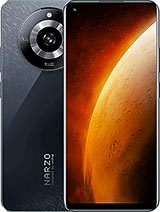
At 182g and 7.9mm thin, the Narzo 60 5G feels light and pocketable, with a slim profile that avoids the bloat many rivals at this price have. The glass front (Gorilla Glass 5) and eco leather or plastic back create a mixed-material look that's practical rather than showy. The plastic frame keeps weight down, though it won't match metal construction in rigidity. There is no IP rating, so don't expect water resistance—a disappointment for a phone launched in 2023, when even midrange competitors at this price often claim dust and water protection.
Display
The 6.43-inch Super AMOLED screen is the standout here. At 1080 x 2400 pixels (409 ppi), it delivers sharp text and vibrant colors that outclass IPS-LCD screens in the same price bracket. The 90Hz refresh rate makes scrolling and swiping noticeably smoother than budget 60Hz panels, and it extends the screen-to-body ratio to 85.7%, so there is minimal bezel distraction. Colors are punchy, blacks are genuine, and the 20:9 aspect ratio suits both video and reading. Brightness levels aren't specified, which is a gap, but AMOLED panels at this tier typically manage daylight visibility without issue.
Performance
The Dimensity 6020 is a mainstream midrange chip that handles messaging, social media, web browsing, and video playback without hiccups. Apps open promptly, multitasking with several tabs or apps in memory is fluid, and everyday use does not expose any stuttering. For light gaming—PUBG at reduced settings, Fortnite on low graphics—it is competent. But demanding 3D titles at high detail or frame rates will tank performance; this is not a gaming phone, and at 200 EUR you should not expect it to be. The 8GB RAM helps keep apps in memory, reducing reload times on frequent switches. It is honest midrange work, neither slow nor particularly clever.
Software
Realme UI 4.0 runs on Android 13. It is fairly clean compared to some Android skins, though Realme still loads its own apps and services on top of Google's, which can clutter the app drawer. Update frequency and long-term support are unknown from the spec sheet, but Realme's track record on midrange phones is hit or miss—some devices get years of patches, others plateau after one or two updates. The underlying Android experience is competent enough for daily use; nothing here stands out as broken or beautifully refined.
Camera
The main 64MP sensor with f/1.8 aperture and PDAF sounds generous for the price, and in good light it captures reasonably sharp, well-exposed shots with natural color. The 1/2.0-inch sensor size and 0.7µm pixel pitch are typical for this tier—fine for social media and modest prints, but not exceptional. There is no ultrawide, macro, or telephoto, so framing is limited; the 25mm focal length suits general shooting but misses out on landscape breadth or subject detail. The 16MP front camera at f/2.5 is adequate for video calls and selfies, though noise creeps in when light drops. Both cameras max out at 1080p@30fps video, which is behind competitors offering 4K or 1080p@60fps at similar prices. For casual photography and social media, it is sufficient; for any ambition beyond that, you will feel the limits quickly.
Battery & Charging
The 5000 mAh battery is a strength. On mixed use—messaging, browsing, some video—expect 15 to 18 hours between charges, stretching to a full day with light traffic or into the evening with heavy use. Heavy gaming or sustained video streaming drains it faster, but for a daily driver it is a comfortable size. Realme lists SuperVOOC charging but does not specify wattage in this spec sheet; Realme's SuperVOOC on midrange phones typically ranges from 30W to 65W, which puts full charge time in the ballpark of 30 to 45 minutes. That is genuinely quick for the price and class, though you will need to carry Realme's own charger (or a compatible VOOC-compatible cable) since a fast charger may not ship in the box.
Value & Verdict
At around 200 EUR, the Narzo 60 5G is well-positioned for someone who wants a sharp AMOLED screen, reliable performance for daily tasks, and 5G connectivity without paying flagship prices. The lack of an IP rating is the loudest omission in a world where even budget phones now sport IP53 or better, and the camera is competent but unremarkable. The chipset is designed for efficiency rather than power, so gaming and heavy creative work are not in its wheelhouse. If AMOLED and everyday smoothness matter more than camera ambition or water resistance, this phone delivers. If you need toughness, a better camera, or sustained gaming performance, look elsewhere in the same price range.
Verdict
It suits someone prioritizing an AMOLED screen and all-day battery over camera richness or water resistance. Skip it if you game seriously, shoot a lot of video, or need a durable, weather-sealed phone.
- Sharp 6.43-inch AMOLED display with 90Hz refresh, vibrant colors, and good screen-to-body ratio
- 5000 mAh battery easily handles 15–18 hours of mixed use, with quick SuperVOOC charging
- Slim, lightweight design at 7.9mm and 182g makes it comfortable to carry
- Dimensity 6020 handles daily apps and light gaming without strain
- No IP rating for dust or water resistance, a gap at this price point in 2023
- Camera limited to 1080p video and single focal length, with no ultrawide or macro modes
- Demanding games and heavy workloads will hit performance limits; not built for sustained high loads
Realme Narzo 60 5G Key Specifications
The essentials at a glance. See the full spec sheet.
| Released | 2023, July 06 |
|---|---|
| Display | 6.43 inches, 99.8 cm2 (~85.7% screen-to-body ratio), Super AMOLED, 90Hz |
| Resolution | 1080 x 2400 pixels, 20:9 ratio (~409 ppi density) |
| Chipset | Mediatek Dimensity 6020 (7 nm) |
| RAM & storage | 128GB 8GB RAM, 256GB 8GB RAM |
| Main camera | 64 MP, f/1.8, 25mm (wide), 1/2.0", 0.7µm, PDAF Auxiliary lens |
| Selfie camera | 16 MP, f/2.5, 26mm (wide) |
| Battery | 5000 mAh |
| Charging | SuperVOOC |
| Software | Android 13, Realme UI 4.0 |
| Dimensions | 159.8 x 72.9 x 7.9 mm (6.29 x 2.87 x 0.31 in) |
| Weight | 182 g (6.42 oz) |
| Build | Glass front (Gorilla Glass 5), eco leather or plastic back, plastic frame |
| Network | GSM / HSPA / LTE / 5G |
| NFC | Unspecified |
| USB | USB Type-C 2.0 |
Realme Narzo 60 5G FAQ
Common questions, answered from the spec sheet.
Does the Narzo 60 5G support 5G?
Yes. The Narzo 60 5G supports 5G networks.
What chipset does the Narzo 60 5G use?
The Narzo 60 5G runs on the Mediatek Dimensity 6020 (7 nm).
What display does the Narzo 60 5G have?
A 6.43 inches, 99.8 cm2 (~85.7% screen-to-body ratio) Super AMOLED, 90Hz, 1080 x 2400 pixels, 20:9 ratio (~409 ppi density).
How big is the Narzo 60 5G battery?
The Narzo 60 5G has a 5000 mAh battery. Charging is rated at SuperVOOC.
Does the Narzo 60 5G have NFC?
No, the Narzo 60 5G does not list NFC support.
Does the Narzo 60 5G support a microSD card?
Yes, the Narzo 60 5G supports expandable storage (microSDXC (dedicated slot)).
Alternatives to consider
If the Narzo 60 5G isn’t quite right, these are the closest calls.
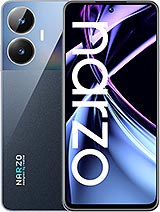
Narzo N55

Narzo N53

10T 5G
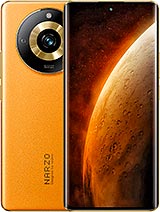
Narzo 60 Pro
Galaxy A06