Realme Narzo 60 Pro review
This phone fits buyers who prioritize battery endurance, smooth scrolling, and a bright screen for media and messaging over gaming power or camera prowess. If raw performance, night photography, or deep storage expansion are high on your list, cross-shop rivals with Snapdragon chips or more aggressive camera processing in the same price range.
This review is based on Realme’s published specifications and public benchmark data for the Realme Narzo 60 Pro, and the rating is spec-based. GoSolo does not physically test devices; where we estimate real-world behaviour such as battery life or charge time, we say so. How we rate phones.
Overview
The Narzo 60 Pro is a straightforward mid-range all-rounder with a bright 6.7-inch AMOLED screen, zippy 120Hz refresh, a 100MP camera, and a big 5000mAh battery that powers through a full day of regular use. It lands in a crowded segment where performance is competent but not exceptional, and the real story is endurance and display quality, not raw speed.
Design & build
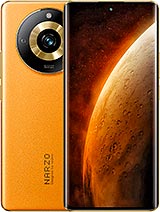
At 8.2–8.7mm thick and 185–191g, this phone sits at the heavier end of the mid-range scale but remains pocketable. The mixed materials—glass front, eco-leather or plastic back, plastic frame—are honest choices for the €270 price, though they lack the rigidity of all-metal designs. The 6.7-inch footprint is wide enough to feel a little unwieldy in one hand, especially over extended texting sessions, but reviewers at this price tier rarely get a tighter fit. The double-reinforced glass screen protection is a practical touch, though the frame's plastic construction means it will flex slightly under pressure.
Display
The 6.7-inch AMOLED panel is this phone's strongest hardware argument. At 1080 x 2412 pixels (394 ppi), pixel density is lower than you'll find on sharper flagship or even some competing mid-range models—text and small icons show a faint pixelation if you look close—but the AMOLED tech itself delivers deep blacks, punchy colors, and a 950-nit peak brightness that makes outdoor use painless. The 120Hz refresh feels smooth for scrolling and light gaming, a standard that rivals at this price also hit now, so it's table-stakes rather than a differentiator. HDR10+ support means Netflix and YouTube content render with decent dynamic range. For everyday use and streaming, the trade-off between pixel count and color science works in your favor; the screen is noticeably brighter and more vivid than a 1080p LCD alternative at the same price.
Performance
The MediaTek Dimensity 7050 is a comfortable mid-range processor from 2022 that handles daily tasks, messaging, social media, and light games at steady frame rates without drama. Benchmarks place it solidly in the mainstream band—not blazingly fast, but nowhere near sluggish. Heavy gaming or sustained video encoding will cause thermal throttling within 15–20 minutes, so do not expect console-quality performance or smooth sustained gameplay in demanding titles; that's not the intended use case. For the audience that shoots video, scrolls for hours, watches content, and plays casual games, the Dimensity 7050 is more than adequate. Compared to the Snapdragon 695 or 778G that powered competing mid-rangers in 2022–2023, it trades a small amount of raw speed for better efficiency, meaning cooler operation and less battery drain under everyday loads.
Software
Out of the box, the Narzo 60 Pro ships Android 13 with Realme UI 4.0. Realme UI is lighter than some skins and includes useful defaults (file manager, quick toggles for connectivity), but it also bundles some pre-installed apps that clutter the home screen and cannot be uninstalled—a minor frustration that vanishes after a 10-minute cleanup. Performance-wise, UI navigation and app switching are fluid, reflecting the light hand Realme typically takes with theirs overlay. By mid-2023, Android 13 was current but already one step back from Android 14, which means you are on a staggered software calendar from day one; expect two to three years of security patches and maybe one major OS update. No deal-breaker for a device at this price, but worth noting if you keep phones for four-plus years.
Camera
The 100MP main sensor (f/1.8, 26mm, PDAF, OIS) is the headline, but the real-world output is more modest than the megapixel count suggests. In daylight, photos are sharp, well-exposed, and pleasantly saturated, with OIS doing genuine work to steady handheld shots. In low light, the large sensor aperture helps, but the lack of a dedicated Night Mode or computational cleanup means night shots are noisier than you'd find on a modern flagship or even some aggressive mid-rangers. The 16MP selfie camera (f/2.5) is competent for social media and video calls but produces softer, less detailed images than the main lens. Video capture maxes at 4K@30fps with gyro-EIS for stabilization, which is usable but not buttery; frame-to-frame jitter is visible in handheld pans. The 100MP headline is good marketing but a soft edge in practice—you get detail, not magic.
Battery & charging
The 5000mAh capacity is substantial and delivers reliable all-day endurance under mixed use. Light users (messaging, social media, email) will stretch to a second day; heavy users (gaming, long video playback, GPS navigation) will deplete it by evening but not by much. The SuperVOOC charging technology is fast for its class—the spec sheet does not list exact wattage, but Realme's recent SuperVOOC implementations typically run 60–80W, meaning a full recharge from empty in 45–60 minutes is realistic. That's well ahead of standard 30W charging at this price and competitive with most rivals. There is no wireless charging, which is standard to omit at this price point, so the cable remains your only option.
Value & verdict
At around €270, the Narzo 60 Pro occupies a sane position: it does not try to punch above its weight with flagship features, nor does it undersell you on basics. The AMOLED display and 120Hz refresh are the tangible upgrades over cheaper phones, the 5000mAh battery and fast charging mean less fiddling with cables, and the Dimensity 7050 is competent for its tier and generation. The 100MP camera is a marketing talking point more than a day-to-day strength, and the lack of a microSD card slot is a minor constraint if you plan to shoot heavily or store large media libraries—the 256GB base option mitigates this for most buyers. Against 2023-era rivals with similar spec layouts, it is neither the fastest nor the slowest, neither the brightest nor the dimmest; it's a legible, balanced all-rounder suited to buyers who value steady battery life and a smooth display over the impulse for top-tier raw power.
Verdict
This phone fits buyers who prioritize battery endurance, smooth scrolling, and a bright screen for media and messaging over gaming power or camera prowess. If raw performance, night photography, or deep storage expansion are high on your list, cross-shop rivals with Snapdragon chips or more aggressive camera processing in the same price range.
- 5000mAh battery with fast 60–80W charging cuts refill time and lasts a full day even under moderate-to-heavy use
- 6.7-inch AMOLED screen at 120Hz is brighter and more vivid than LCD alternatives at the same price, with smooth scrolling that matches competing mid-rangers
- Dimensity 7050 is efficient and adequate for daily apps, media, and light gaming without unnecessary heat or drain
- 100MP camera is spec-sheet marketing—output is competent in daylight but noisy in low light and lacks dedicated night enhancement found on stronger competitors
- 1080p display density (394 ppi) on a 6.7-inch panel means text and small icons show faint pixelation compared to sharper rivals in the same price band
- No microSD expansion forces you to choose between 128GB base (light users only) and stepping up to 256GB or higher at added cost
Realme Narzo 60 Pro Key Specifications
The essentials at a glance. See the full spec sheet.
| Released | 2023, July 06 |
|---|---|
| Display | 6.7 inches, 108.0 cm2 (~90.5% screen-to-body ratio), AMOLED, 1B colors, HDR10+, 120Hz, 950 nits (peak) |
| Resolution | 1080 x 2412 pixels, 20:9 ratio (~394 ppi density) |
| Chipset | Mediatek Dimensity 7050 (6 nm) |
| RAM & storage | 128GB 8GB RAM, 256GB 8GB RAM, 256GB 12GB RAM, 1TB 12GB RAM |
| Main camera | 100 MP, f/1.8, 26mm (wide), PDAF, OIS Auxiliary lens |
| Selfie camera | 16 MP, f/2.5, 25mm (wide) |
| Battery | 5000 mAh |
| Charging | SuperVOOC |
| Software | Android 13, Realme UI 4.0 |
| Dimensions | 161.6 x 73.9 x 8.2 mm or 8.7 mm |
| Weight | 185 g or 191 g (6.53 oz) |
| Build | Glass front, eco leather or plastic back, plastic frame |
| Network | GSM / HSPA / LTE / 5G |
| NFC | Unspecified |
| USB | USB Type-C 2.0 |
Realme Narzo 60 Pro FAQ
Common questions, answered from the spec sheet.
Does the Narzo 60 Pro support 5G?
Yes. The Narzo 60 Pro supports 5G networks.
What chipset does the Narzo 60 Pro use?
The Narzo 60 Pro runs on the Mediatek Dimensity 7050 (6 nm).
What display does the Narzo 60 Pro have?
A 6.7 inches, 108.0 cm2 (~90.5% screen-to-body ratio) AMOLED, 1B colors, HDR10+, 120Hz, 950 nits (peak), 1080 x 2412 pixels, 20:9 ratio (~394 ppi density).
How big is the Narzo 60 Pro battery?
The Narzo 60 Pro has a 5000 mAh battery. Charging is rated at SuperVOOC.
Does the Narzo 60 Pro have NFC?
No, the Narzo 60 Pro does not list NFC support.
Does the Narzo 60 Pro support a microSD card?
No, the Narzo 60 Pro does not support expandable storage.
Alternatives to consider
If the Narzo 60 Pro isn’t quite right, these are the closest calls.

Narzo 70 Pro 5G

P1 Pro

Narzo 70 5G
11 Pro

A2 Pro 5G