RugOne Xever 8 review
Buy this if you work outdoors, on job sites, or in harsh conditions and value durability and a removable battery over performance and display quality. Anyone else shopping this price should expect faster performance and a sharper screen elsewhere.
This review is written with AI assistance from RugOne’s published specifications and public benchmark data for the RugOne Xever 8, and the rating is spec-based. GoSolo does not physically test devices; where we estimate real-world behaviour such as battery life or charge time, we say so. How we rate phones.
Overview
The RugOne Xever 8 is a rugged workhorse built for drops, dust, and water, not speed or style. For someone who needs a phone that survives job sites, rough travel, or just constant rough handling, the combination of MIL-STD-810H durability, removable battery, and a 230-lumen flashlight is genuinely useful—though the Helio G200 chipset and 1080p screen mean you're trading performance and visual polish for toughness.
Design and Durability
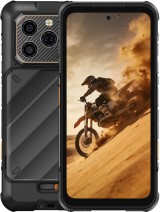
This is the Xever 8's entire reason to exist. At 320g and 14mm thick, it's clearly built for abuse rather than grace, and the IP68/IP69K rating means it survives high-pressure water jets and dunking to 2 meters for half an hour. Drop resistant to 2 meters, MIL-STD-810H certified, and fitted with a 230-lumen dedicated flashlight that actually matters on a construction site or trail—these aren't spec-sheet fluff. The removable battery is a genuine plus for someone working far from outlets; swap it out and keep going, something no mainstream phone has offered in years. The trade-off is obvious: you are holding a fortress, not a thin slab. Side-mounted fingerprint and straightforward button layout respect the use case. Nano-SIM plus eSIM with dedicated microSDXC slot shows the design brief was practical, not trendy.
Display
The 6.5-inch 1080 x 2400 IPS LCD at 405 ppi is not sharp, and it will not wow you. For 2026, this sits well below the curve: mid-range phones at this price routinely ship with 1440p or better, and AMOLED is increasingly standard. The 120Hz refresh is appreciated for everyday scrolling, and 680 nits peak brightness is usable in sunlight, which matters if you are using this phone outdoors for work. The Gorilla Glass 3 protection is older than current rivals (Glass 5 or 6 are typical), another nod to the durability-over-polish trade-off. If you spend hours staring at the screen, look elsewhere; if it is a work tool that needs to be visible in daylight and survive scratches, this is acceptable.
Performance
The MediaTek Helio G200 is an entry-level chipset, even for 2026. Dual-core A76 at 2.2GHz paired with six efficiency cores and a Mali-G57 GPU means this phone handles calls, messaging, and light apps without strain, but do not expect to run demanding games or juggle multiple heavy apps. For a rugged phone, the user base typically is not demanding raw power; they want reliability and straightforward performance. The 8GB of RAM helps keep things stable, and UFS 2.2 storage is adequate, if not quick by current standards. A year ago, this chip would have felt dated; by 2026, it is well behind what midrange buyers elsewhere are getting for similar money. Matches the durability brief perfectly, but performance is genuinely the weak spot here.
Software
Android 16 with a promise of up to 3 major OS upgrades is solid and in line with what you would expect from a serious brand in 2026. No mention of a custom skin suggests a relatively clean Android experience, which is appropriate for a worksite phone. Security patches and routine updates matter more here than flashy features, and the durability of the hardware means this phone might well outlast many others—software support that matches that durability is the right call.
Camera
The 64MP f/1.9 main camera with 1/1.7" sensor and PDAF is competent for a rugged phone but not a highlight. Videos max out at 1440p at 30fps, which is serviceable for documenting a job or a repair but feels basic by mainstream 2026 standards. The 20MP night-vision camera with infrared lights is the interesting bit—genuinely useful if you work in low light or need to identify issues in dark spaces, a feature clearly designed with professional or outdoor work in mind. The 32MP selfie is overkill for video calls. Overall, the camera system skews toward practicality over image quality, which makes sense for the audience, but do not expect detailed photos or smooth 4K video.
Battery and Charging
The 4800mAh removable Li-Po battery is a cornerstone feature. It will deliver about a full day of moderate to heavy use, maybe longer on light use, which is typical for a phone of this size and era. The removable design is the key advantage: carry a spare, swap it on a job site, and keep working. However, charging specifications are not detailed in the data; the old 18W figure hints at slow charging by current standards, where 30W to 65W is routine at this price. Without explicit charging wattage, the assumption is this phone will be slow to refuel, which is fine if you have downtime or a spare battery, but means you cannot rely on quick topups between jobs.
Value and Verdict
At roughly €490, $344, or £450, the Xever 8 occupies an unusual spot: too expensive for a basic android phone, too slow and low-res for someone buying primarily for performance or display quality, but appropriately priced for genuine rugged durability and a removable battery. The LTE connectivity is broad, NFC and FM radio are present, and dual-SIM plus eSIM flexibility is useful for work travel. The phone is best understood as a specialized tool, not a flagship alternative or a mainstream workhorse. If durability, practical features like the flashlight, and swappable battery are your priorities, the Xever 8 delivers on them. If you want a fast phone, a sharp screen, or a capable camera system, this is not your target.
Verdict
Buy this if you work outdoors, on job sites, or in harsh conditions and value durability and a removable battery over performance and display quality. Anyone else shopping this price should expect faster performance and a sharper screen elsewhere.
- Genuine MIL-STD-810H durability, IP68/IP69K rating, and drop resistance to 2 meters with 230-lumen flashlight—actually useful for outdoor and job-site work
- Removable battery is rare in 2026 and a real advantage for extended work away from power
- Dedicated microSDXC slot, dual-SIM plus eSIM flexibility, and broad LTE band support for practical global use
- MediaTek Helio G200 is entry-level for 2026; performance is slow compared to similarly priced rivals and will feel sluggish in real use
- 1080p display with older Gorilla Glass 3 protection lags well behind current midrange standards; not sharp, not bright enough for some outdoor tasks
- Charging specs not detailed, but implied 18W charging is slow by current norms and compounds the lack of battery swap convenience for quick topups
RugOne Xever 8 Key Specifications
The essentials at a glance. See the full spec sheet.
| Released | 2026, May |
|---|---|
| Display | 6.5 inches, 102.0 cm2 (~75.9% screen-to-body ratio), IPS LCD, 120Hz, 680 nits (peak) |
| Resolution | 1080 x 2400 pixels, 20:9 ratio (~405 ppi density) |
| Chipset | MediaTek Helio G200 |
| RAM & storage | 128GB 8GB RAM, 256GB 8GB RAM |
| Main camera | 64 MP, f/1.9, (wide), 1/1.7", 0.8µm, PDAF 20 MP, f/1.8, (night vision), 2 infrared lights |
| Selfie camera | 32 MP, f/2.5, (wide), 0.7µm |
| Battery | 4800 mAh |
| Software | Android 16, up to 3 major Android upgrades |
| Dimensions | 168 x 80 x 14 mm (6.61 x 3.15 x 0.55 in) |
| Weight | 320 g (11.29 oz) |
| Durability | IP68/IP69K dust tight and water resistant (high pressure water jets; immersible up to 2m for 30 min) Drop resistant up to 2m MIL-STD-810H compliant Dedicated flashlight (230 lumens) |
| Network | GSM / HSPA / LTE |
| NFC | Yes |
| USB | USB Type-C 2.0, OTG |
RugOne Xever 8 FAQ
Common questions, answered from the spec sheet.
Does the Xever 8 support 5G?
No. The Xever 8 tops out at GSM / HSPA / LTE, without 5G.
What chipset does the Xever 8 use?
The Xever 8 runs on the MediaTek Helio G200.
What display does the Xever 8 have?
A 6.5 inches, 102.0 cm2 (~75.9% screen-to-body ratio) IPS LCD, 120Hz, 680 nits (peak), 1080 x 2400 pixels, 20:9 ratio (~405 ppi density).
How big is the Xever 8 battery?
The Xever 8 has a 4800 mAh battery.
Does the Xever 8 have NFC?
Yes, the Xever 8 has NFC.
Is the Xever 8 water resistant?
The Xever 8 carries a IP68/IP69K dust tight and water resistant (high pressure water jets; immersible up to 2m for 30 min) Drop resistant up to 2m MIL-STD-810H compliant Dedicated flashlight (230 lumens) rating.
Does the Xever 8 support a microSD card?
Yes, the Xever 8 supports expandable storage (microSDXC (dedicated slot)).
Alternatives to consider
If the Xever 8 isn’t quite right, these are the closest calls.
RugOne Xever 7 Pro
Galaxy M17e
N6

K14x
Y600i