Samsung Galaxy M14 review
Buy this if you spend most time on messaging, social media, and video, value a big smooth screen and all-day battery, and don't game or shoot often. Look elsewhere if you demand fast charging, gaming performance, or a camera that impresses beyond casual snapshots.
This review is based on Samsung’s published specifications and public benchmark data for the Samsung Galaxy M14, and the rating is spec-based. GoSolo does not physically test devices; where we estimate real-world behaviour such as battery life or charge time, we say so. How we rate phones.
Overview
The Galaxy M14 is a straightforward large-screen workhorse built for everyday messaging and streaming, with a smooth 90Hz display and solid battery life. It's competent but makes no case beyond basics—the Exynos 1330 struggles with demanding games, and there's no fast charging despite the 6000 mAh cell.
Design & build
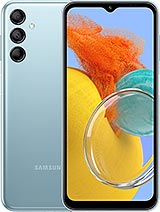
The M14 weighs 206 g and sits at 9.4 mm thick—solidly normal for a 6.6-inch phone in 2023. Gorilla Glass 5 on the front signals durability; the plastic back and frame are par for the course at this price, and they keep it light. The side-mounted fingerprint scanner is reliable and convenient. You get dual SIM flexibility and a dedicated microSD slot, which many rivals have scrapped. It's unremarkable in hand, but that's not a fault at 200 EUR.
Display
The 6.6-inch PLS LCD panel runs at 90Hz and 1080 x 2408 pixels, yielding 400 ppi—sharp enough for text and web browsing at arm's length. That 90Hz refresh is the standout here; scrolling through apps and social feeds noticeably smoother than the 60Hz panels still common in this bracket. The LCD is not OLED, so blacks are gray and battery drain from high brightness is noticeable, but outdoor legibility is actually decent. For a budget phone chasing a big screen, this trades depth for size and movement, and the tradeoff suits its purpose.
Performance
The Exynos 1330—two 2.4 GHz Cortex-A78 cores paired with six efficiency cores—handles everyday tasks without hesitation. Apps open fast, messaging flows, and video streaming is smooth. This is mainstream midrange silicon; it does what most people need. Gaming, however, shows its limits quickly. Light titles (Candy Crush, Sudoku) run flawlessly, but anything demanding—Call of Duty Mobile, PUBG, Genshin Impact—hits frame drops at high settings or requires you to cut graphical detail. With 4GB RAM as the base, you're also closer to Android's memory wall than you want. The 6GB option is worth considering if you multitask heavily or install many apps.
Software
Android 13 with One UI Core 5.1 is clean and responsive. Samsung's lightened-down interface avoids bloat, though it still includes its own apps you may not need. Update support is typically three years for Galaxy M phones, so security patches should arrive regularly through 2026. Nothing revolutionary, but stable and familiar.
Camera
The 50MP main sensor with f/1.8 aperture and PDAF sounds respectable on paper until you remember Samsung outputs 1080p video and the actual photo quality lags phones with smaller sensor counts but better processing. The 2MP macro is filler—it doesn't add meaningful range, just a checkbox. The 13MP selfie handles video calls and selfies without complaint. Daytime photos are acceptable under good light; shadows and low light expose the sensor's small size and modest aperture. There's no night mode to compensate. For social media and family snaps, it's adequate. For anything beyond that, you'll notice the limits. LED flash is present but doesn't redeem the overall package.
Battery & charging
The 6000 mAh cell is genuinely generous and returns around 15 to 18 hours of mixed use—messages, social media, some video. Heavy gaming or screen-on time shortens that to a full day, but it's still a week-level figure compared to rivals stopping at 5000 mAh. The absent charging speed in the spec sheet is telling; at this price, most competitors have moved to 30W, 65W, or higher. Samsung's silence here suggests 15W or 25W maximum, which means you'll need 2.5+ hours to fully charge from flat. That's a real friction point in 2023, even for a budget phone.
Value & verdict context
At around 200 EUR, the M14 slots into the entry-midrange tier. Compared to the Redmi Note or Realme rivals at the same price, it holds its own with the 90Hz display, long battery, and Samsung's software reputation. It loses out on charging speed and gaming chops. It's not a flagship killer or a wild bargain—it's a safe, competent phone for someone whose main activities are messaging, social media, and streaming, with enough longevity to survive daily use without stuttering. The trade-offs are clear: you get size, battery life, and software smoothness; you give up charging speed, gaming performance, and camera ambition.
Verdict
Buy this if you spend most time on messaging, social media, and video, value a big smooth screen and all-day battery, and don't game or shoot often. Look elsewhere if you demand fast charging, gaming performance, or a camera that impresses beyond casual snapshots.
- 90Hz display keeps scrolling and swiping noticeably smoother than the 60Hz phones still common at this price
- 6000 mAh battery easily lasts a full day of moderate use, comfortably beating rivals that stop at 5000 mAh
- MicroSD slot lets you expand storage without paying Samsung's premium for extra internal capacity
- 5G and dual SIM make it flexible for work-and-personal setups or travel
- No charging speed listed in the spec, but the omission at this price point suggests it lacks the 30W or 65W charging rivals offer
- Exynos 1330 drops frames in any demanding game; this is purely for light apps and video
- 50MP main camera is spec-sheet filler—1080p output and f/1.8 aperture are modest, and the 2MP macro is decorative
Samsung Galaxy M14 Key Specifications
The essentials at a glance. See the full spec sheet.
| Released | 2023, March 08 |
|---|---|
| Display | 6.6 inches, 104.9 cm2 (~81.5% screen-to-body ratio), PLS LCD, 90Hz |
| Resolution | 1080 x 2408 pixels, 20:9 ratio (~400 ppi density) |
| Chipset | Exynos 1330 (5 nm) |
| RAM & storage | 64GB 4GB RAM, 128GB 4GB RAM, 128GB 6GB RAM |
| Main camera | 50 MP, f/1.8, (wide), PDAF 2 MP (macro) Auxiliary lens |
| Selfie camera | 13 MP, f/2.0, (wide) |
| Battery | 6000 mAh |
| Software | Android 13, One UI core 5.1 |
| Dimensions | 166.8 x 77.2 x 9.4 mm (6.57 x 3.04 x 0.37 in) |
| Weight | 206 g (7.27 oz) |
| Build | Glass front (Gorilla Glass 5), plastic back, plastic frame |
| Network | GSM / HSPA / LTE / 5G |
| NFC | Yes |
| USB | USB Type-C 2.0 |
Samsung Galaxy M14 FAQ
Common questions, answered from the spec sheet.
Does the Galaxy M14 support 5G?
Yes. The Galaxy M14 supports 5G networks.
What chipset does the Galaxy M14 use?
The Galaxy M14 runs on the Exynos 1330 (5 nm).
What display does the Galaxy M14 have?
A 6.6 inches, 104.9 cm2 (~81.5% screen-to-body ratio) PLS LCD, 90Hz, 1080 x 2408 pixels, 20:9 ratio (~400 ppi density).
How big is the Galaxy M14 battery?
The Galaxy M14 has a 6000 mAh battery.
Does the Galaxy M14 have NFC?
Yes, the Galaxy M14 has NFC.
Does the Galaxy M14 support a microSD card?
Yes, the Galaxy M14 supports expandable storage (microSDHC (dedicated slot)).
Alternatives to consider
If the Galaxy M14 isn’t quite right, these are the closest calls.
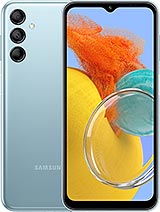
Galaxy M14 4G
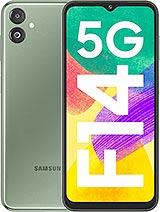
Galaxy F14
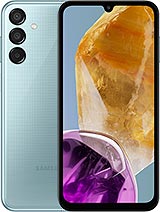
Galaxy M15 5G
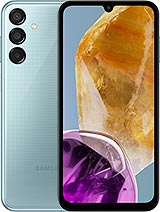
Galaxy M15
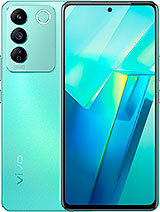
T2 5G