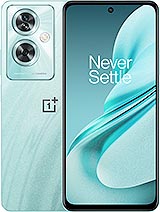
Umidigi G3 Max review
The G3 Max suits people in LTE-covered regions who prioritize a large screen and all-day battery over charging speed and cellular modernity. If you live somewhere 5G is standard, or you value charging convenience, or you need responsive multitasking, look elsewhere.
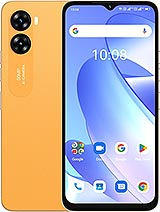
This review is based on Umidigi’s published specifications and public benchmark data for the Umidigi G3 Max, and the rating is spec-based. GoSolo does not physically test devices; where we estimate real-world behaviour such as battery life or charge time, we say so. How we rate phones.
Overview
The Umidigi G3 Max is a large-screen, long-battery phone for people who value screen real estate and all-day stamina over raw pace. It delivers on those two fronts but stumbles where it matters most: charging speed is glacial, the chip is entry-level, and you're locked into LTE-only connectivity in an era when faster networks are becoming standard.
Design & build
At 192 grams and 8.8 mm thick, the G3 Max feels light and trim in hand, which matters on a 6.6-inch phone. The dual nano-SIM design is practical for region-hoppers, though the shared microSD slot means you're choosing between a second line and storage expansion. The body itself—materials and finish—isn't detailed in the spec sheet, so there's little to judge beyond weight and dimensions. For the price and market segment, build quality is likely adequate but unremarkable.
Display
The 6.6-inch IPS LCD is the phone's headline strength. At 1080 x 2408 pixels (20:9 aspect), it delivers 400 ppi, which is sharp enough for reading text comfortably at normal viewing distance. IPS means wide angles and no color shift when tilting, the standard for reliability. The 84.6% screen-to-body ratio is respectable. The drawback is that 1080p on this diagonal is now pedestrian; rivals in this space often step up to 1440p or AMOLED, and the absence of a refresh rate specification hints this is a standard 60 Hz panel. For video and media, it's fine; for text clarity on a device this large, it trades finesse for adequacy.
Performance
The Unisoc T606 is unapologetically entry-level. Its octa-core design (two faster 1.6 GHz Cortex-A75 cores flanked by six slower A55 cores) handles everyday apps, messaging, and video streaming without fuss. Where it breaks down is demanding games, sustained multitasking, and app-switching lag. If you jump between five apps rapidly or run a game that taxes the GPU, expect delays and frame drops. For someone checking messages, browsing, and watching video, it is adequate; for power users or mobile gamers, it will frustrate. The Mali-G57 MP1 GPU is minimal; think of it as a phone that moves through daily tasks but does not sprint.
Software
Android 13 on a 2023 phone is now two versions behind (Android 15 is current), which raises a fair question about how long Umidigi will update this device. The spec sheet does not detail update commitments or security patch frequency, so assume standard support: perhaps one major Android upgrade and 2–3 years of security patches. Out of the box, Android 13 is stable and familiar, but buyers planning to keep this phone beyond 2–3 years should factor in potential obsolescence.
Camera
The 50 MP f/1.8 main camera is the best-specced part of the G3 Max. The wide aperture captures detail in daylight and helps in low light, and the auxiliary lens suggests basic computational photography. Outputs are likely clean in good light, with the dual-LED flash aiding indoor shots. The letdown is video: locked at 1080p@30fps, it lacks the 4K resolution rivals now offer even in this price tier, so playback on large screens reveals a soft, pixelated image. The 8 MP selfie is adequate for video calls but nothing more. Overall, it is a solid daytime phone held back by dated video capability.
Battery & charging
The 5150 mAh battery is substantial and will push through a full day of moderate use (messages, browsing, music) without strain. Heavy video streaming or gaming will drain it faster, cutting into evening use. The real limiter is charging: 10W wired is painfully slow by today's standards. Rivals at similar or lower prices now pack 65–100W charging, cutting full-charge time to 30–50 minutes. Here, expect 2–3 hours tethered to an outlet, which makes the phone impractical for quick top-ups before leaving home. If you charge every night, it is livable; if you need flexibility, it is a dealbreaker.
Value & verdict-context
In 2023 and into 2024, the G3 Max occupies an awkward middle ground: it costs less than a modern mid-range flagship but punches below that class in meaningful ways. The lack of 5G in 2023 is a significant oversight, especially in markets where carriers are deprecating LTE in favor of faster networks. The 10W charging is a relic by 2024 standards. What it does offer—screen size, battery endurance, storage and audio jack—appeals to a specific buyer: someone in a region with solid LTE coverage who watches a lot of video, works from home, and does not need to top up quickly. For that person, it is honest value. For everyone else, the gaps become harder to ignore.
Verdict
The G3 Max suits people in LTE-covered regions who prioritize a large screen and all-day battery over charging speed and cellular modernity. If you live somewhere 5G is standard, or you value charging convenience, or you need responsive multitasking, look elsewhere.
- Generous 6.6-inch display with solid 400 ppi sharpness, adequate for reading and media on this scale
- 5150 mAh battery easily carries through a full day of moderate use without strain
- Keeps both 3.5mm jack and microSD expansion, rare niceties on modern phones at any price
- 50 MP main camera with f/1.8 aperture captures respectable daylight detail and handles low light reasonably well
- 10W charging takes 2–3 hours for a full charge, far slower than peers now hitting 65–100W
- Unisoc T606 is entry-level; expect stuttering in heavy multitasking and app switching
- LTE-only, no 5G—a significant lag for a 2023 phone, especially in regions rolling out faster networks
Umidigi G3 Max Key Specifications
The essentials at a glance. See the full spec sheet.
| Released | 2023 |
|---|---|
| Display | 6.6 inches, 104.9 cm2 (~84.6% screen-to-body ratio), IPS LCD |
| Resolution | 1080 x 2408 pixels, 20:9 ratio (~400 ppi density) |
| Chipset | Unisoc T606 (12 nm) |
| RAM & storage | 128GB 8GB RAM |
| Main camera | 50 MP, f/1.8, (wide), AF Auxiliary lens |
| Selfie camera | 8 MP, f/2.2, (wide) |
| Battery | 5150 mAh |
| Charging | 10W wired |
| Software | Android 13 |
| Dimensions | 163.9 x 75.7 x 8.8 mm (6.45 x 2.98 x 0.35 in) |
| Weight | 192 g (6.77 oz) |
| Network | GSM / HSPA / LTE |
| NFC | No |
| USB | USB Type-C, OTG |
Umidigi G3 Max FAQ
Common questions, answered from the spec sheet.
Does the G3 Max support 5G?
No. The G3 Max tops out at GSM / HSPA / LTE, without 5G.
What chipset does the G3 Max use?
The G3 Max runs on the Unisoc T606 (12 nm).
What display does the G3 Max have?
A 6.6 inches, 104.9 cm2 (~84.6% screen-to-body ratio) IPS LCD, 1080 x 2408 pixels, 20:9 ratio (~400 ppi density).
How big is the G3 Max battery?
The G3 Max has a 5150 mAh battery. Charging is rated at 10W wired.
Does the G3 Max have NFC?
No, the G3 Max does not list NFC support.
Does the G3 Max support a microSD card?
Yes, the G3 Max supports expandable storage (microSDXC (uses shared SIM slot)).
Does the G3 Max have a headphone jack?
Yes, the G3 Max has a 3.5mm headphone jack.
Alternatives to consider
If the G3 Max isn’t quite right, these are the closest calls.
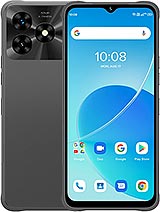
G5 Mecha
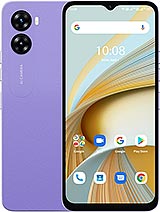
G3 Plus
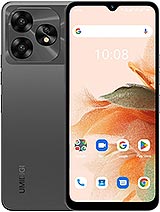
A15C
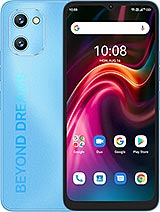
G1 Max
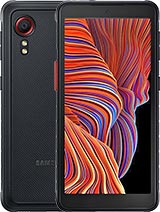
Galaxy XCover 7