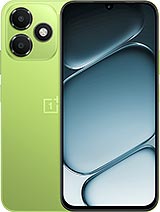
Umidigi Note 100 review
This phone suits someone who values battery endurance, screen real estate, and practical connectivity—dual SIM, 5G, FM radio—over pixel perfection or performance headroom. Anyone who treats their phone as a content-consumption and communication device that needs to outlast a full day will find it purposeful. Skip it if you read small text often, charge wirelessly, or want room for demanding apps and games.

This review is written with AI assistance from Umidigi’s published specifications and public benchmark data for the Umidigi Note 100, and the rating is spec-based. GoSolo does not physically test devices; where we estimate real-world behaviour such as battery life or charge time, we say so. How we rate phones.
Overview
The Umidigi Note 100 delivers genuine value for money with a big 6.8-inch screen, 5G connectivity, and a 5000mAh battery that lives for days—but the 720p display softness and slow Unisoc chipset remind you that you're shopping budget, not mid-range. It makes sense for people who value practicality and endurance over sharpness or gaming, and the price tag is honest about what you're getting.
Design & build
The Note 100 feels like a practical phone rather than a prestige object. At 190 grams and 7.7mm thick, it's substantial but not unwieldy for a 6.8-inch display. Glass front, plastic back and frame is the honest material mix for the price—it will pick up fingerprints and scratches over time, but the build doesn't feel cheap or flimsy. The side-mounted fingerprint sensor is convenient, and the inclusion of a 3.5mm jack and FM radio shows Umidigi thinking about utility over thinness. Dual SIM support is practical for work-personal separation or regional travel, and the shared microSDXC slot lets you expand storage if you need it.
Display
A 6.8-inch screen is genuinely large and makes watching video or reading comfortable without a tablet. The 120Hz refresh rate on an IPS LCD panel makes scrolling smooth and swiping responsive, which is the right priority for a budget phone. However, 720p resolution on this diagonal is the trade-off you feel every day. At 258 ppi, text and icons look softer than a 1080p panel would at the same size, and small UI details blur slightly when you look closely. For messaging, social media, and video, it works fine; for reading small text or gaming where clarity matters, a budget phone with 1080p display will serve you better. The choice here is screen size over sharpness.
Performance
The Unisoc T765 is a solid upper-midrange chipset for early 2025—it handles messaging, browsing, social media, and light 2D games smoothly without lag. Heavy 3D games will require settings compromises or stutter, and demanding apps may take a moment to load, but for everyday work it keeps up. RAM options are 6GB or 8GB; the 8GB variant is the sensible pick if you multitask often. The Mali-G57 GPU is not a gaming engine, and the octa-core CPU prioritizes efficiency over raw speed. This is where you're not paying for overkill, and it shows in battery life; it's also where you accept that cutting-edge performance is not the point of this phone.
Software
Android 14 runs stock with minimal bloat, which is refreshing at the budget end. Updates are where Umidigi phones historically fall behind: you can count on this one receiving Android 15 and maybe 16, but long-term support is shorter than Samsung or OnePlus. Performance remains responsive throughout a full day of use, and the lack of heavy customization means the 6GB or 8GB RAM isn't wasted on system overhead. If you value simplicity and don't need five years of guaranteed updates, the software approach here is honest.
Camera
The 50MP main sensor is typical for budget phones in 2025—impressive on spec sheets, less so in practice. Daylight shots are acceptable, with good detail in well-lit scenes, but the real-world difference between 50MP and 48MP is negligible. The 2MP macro lens is a gimmick that rarely improves photos you'd want to keep, and the 16MP selfie camera is adequate for video calls. The absence of an ultrawide or telephoto is noticeable if you shoot varied scenes, and 1080p@30fps video is standard but not expandable. Low-light performance will disappoint given the megapixel count; the Mali-G57's computational photography is basic. For casual shots and social media, it suffices. For anyone serious about photography, the camera setup is a budget compromise.
Battery & charging
The 5000mAh battery is this phone's strongest selling point. With moderate daily use—messaging, browsing, social media, a bit of video—expect to reach the end of the day with 15–25 percent charge remaining, and a second day of light use is realistic. Heavy video watching or gaming will drain it to 20 percent by evening, but you're still seeing full days. Standby time is excellent thanks to the efficient Unisoc chipset. The 20W charger fills the battery in about 60 to 90 minutes from empty, which is standard for this capacity and wattage. By 2025 standards, charging speed is respectable but no longer quick; rivals at this price are hitting 30–40W, cutting charge time to 40–50 minutes. Battery life is genuine; charging is practical if not fast.
Value & verdict
At around 120 EUR, the Note 100 occupies a shrinking space: the budget-conscious buyer who prioritizes endurance, screen size, and practical features like dual SIM and FM radio over display sharpness or charging speed. It is not trying to be a mid-range phone dressed down; it is an honest budget phone that knows its limits. Rivals offer better charging speeds and sharper displays, but few pack a 5G radio, dual SIM, 120Hz display, and 5000mAh battery at this price together. The trade-offs—720p softness, casual-gaming-only performance, basic camera—are visible and deliberate. If your priority is a phone that runs all day, fits a large screen in a reasonable body, and costs as little as possible, this makes sense. If you want a sharp display, fast charging, or gaming capability, spend a bit more or look for a 2024 mid-range model on sale.
Verdict
This phone suits someone who values battery endurance, screen real estate, and practical connectivity—dual SIM, 5G, FM radio—over pixel perfection or performance headroom. Anyone who treats their phone as a content-consumption and communication device that needs to outlast a full day will find it purposeful. Skip it if you read small text often, charge wirelessly, or want room for demanding apps and games.
- 5000mAh battery easily lasts a full day of heavy use and into a second day with moderation; 20W charging tops it in about an hour
- 6.8-inch 120Hz LCD is genuinely large and smooth to scroll, with an 86 percent screen-to-body ratio that keeps the phone reasonably compact
- 5G radio (where supported), dual SIM, FM radio, and a 3.5mm jack give it practical versatility that modern budget phones often skip
- Unisoc T765 handles everyday apps and light gaming without strain; Android 14 with stock interface is fast enough for its class
- 720p on a 6.8-inch display results in soft text and noticeable pixelation compared to 1080p rivals at this price; 258 ppi density is weak for the size
- 20W charging and the Unisoc T765 are solid for budget 2025, but competitors already offer 30–40W charging and faster chips at the same price
- 1080p video capture and basic low-light camera performance don't justify the 50MP sensor; macro mode is nice but rarely useful
Umidigi Note 100 Key Specifications
The essentials at a glance. See the full spec sheet.
| Released | 2025, February 13 |
|---|---|
| Display | 6.8 inches, 111.6 cm2 (~86.0% screen-to-body ratio), IPS LCD, 120Hz |
| Resolution | 720 x 1600 pixels, 20:9 ratio (~258 ppi density) |
| Chipset | Unisoc T765 (6 nm) |
| RAM & storage | 128GB 6GB RAM, 256GB 8GB RAM |
| Main camera | 50 MP, (wide), AF 2 MP (macro) Auxiliary lens |
| Selfie camera | 16 MP, (wide) |
| Battery | 5000 mAh |
| Charging | 20W wired |
| Software | Android 14 |
| Dimensions | 167.8 x 77.4 x 7.7 mm (6.61 x 3.05 x 0.30 in) |
| Weight | 190 g (6.70 oz) |
| Build | Glass front, plastic back, plastic frame |
| Network | GSM / HSPA / LTE / 5G |
| NFC | No |
| USB | USB Type-C, OTG |
Umidigi Note 100 FAQ
Common questions, answered from the spec sheet.
Does the Note 100 support 5G?
Yes. The Note 100 supports 5G networks.
What chipset does the Note 100 use?
The Note 100 runs on the Unisoc T765 (6 nm).
What display does the Note 100 have?
A 6.8 inches, 111.6 cm2 (~86.0% screen-to-body ratio) IPS LCD, 120Hz, 720 x 1600 pixels, 20:9 ratio (~258 ppi density).
How big is the Note 100 battery?
The Note 100 has a 5000 mAh battery. Charging is rated at 20W wired.
Does the Note 100 have NFC?
No, the Note 100 does not list NFC support.
Does the Note 100 support a microSD card?
Yes, the Note 100 supports expandable storage (microSDXC (uses shared SIM slot)).
Does the Note 100 have a headphone jack?
Yes, the Note 100 has a 3.5mm headphone jack.
Alternatives to consider
If the Note 100 isn’t quite right, these are the closest calls.

Note 100 4G

Note 100A
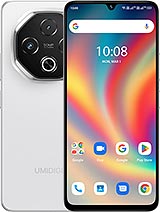
G100 Pro
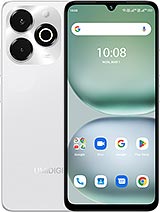
G100x
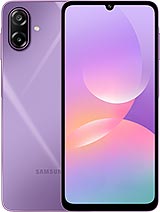
Galaxy M17e