Vivo iQOO Neo 7 Pro review
The Neo 7 Pro suits power users and gamers who prioritise fast charging and raw CPU muscle over a refined all-rounder package. Anyone who values a sharp display, a capable ultrawide, or multi-year software support should cross-shop instead—the price premium for those tradeoffs elsewhere is slim."
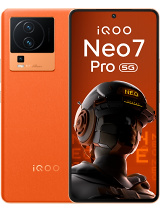
This review is based on Vivo’s published specifications and public benchmark data for the Vivo iQOO Neo 7 Pro, and the rating is spec-based. GoSolo does not physically test devices; where we estimate real-world behaviour such as battery life or charge time, we say so. How we rate phones.
Overview
The iQOO Neo 7 Pro is a mid-range phone with flagship guts—a Snapdragon 8+ Gen 1 and 120W charging—wrapped in a large AMOLED screen, but it cuts corners where it counts: a 1080p display on a 6.78-inch panel, a weak ultrawide camera, and 4K video capped at 30fps make it feel like a last-gen flagship repurposed for the value market, not a fresh proposition at this price.
Design & build
At 197–202g and 8.5mm thick, the Neo 7 Pro sits comfortably between trim and sturdy. The plastic frame and glass-or-leather back are par for the tier; it looks and feels competent without pretension. The 6.78-inch footprint is wide and tall—not pocket-hostile, but not dainty either. Build quality reads solid enough for daily handling, though the plastic frame doesn't scream durability the way metal would at this price. For a device crossing into mid-range territory, the industrial design is functional and forgettable, which is exactly what it should be.
Display
The 1300-nit peak brightness AMOLED is genuinely readable in direct sunlight, and the 120Hz refresh makes scrolling through apps and feeds feel fluid. But here is the rub: 1080p resolution squeezed into 6.78 inches yields 388 ppi, which is perceptibly softer than the 1440p panels on rivals in this space. Text and UI elements lack the crispness you would expect from a 2023 phone at this size and price point. The HDR10+ certification is welcome for video, but the low pixel density undercuts the immersion an AMOLED panel should deliver. For video and gaming, the screen does its job; for reading, it feels like a step back.
Performance
The Snapdragon 8+ Gen 1 and Adreno 730 GPU are built for heavy lifting. Games like Genshin Impact run at high settings without stutter in bursts, and everyday apps launch without lag. The 12GB RAM variant (the sensible pick over 8GB) keeps multitasking smooth. The catch: in extended gaming sessions, sustained frame rates dip as thermal throttling kicks in—the 8.5mm chassis leaves little headroom for heat dissipation. This is a phone that handles power, but not indefinitely. By mid-2023, the 8+ Gen 1 was already approaching obsolescence next to the newer flagship silicon, so you are banking on a year-old chip at a year-old price point.
Software
Android 13 with Funtouch 13 is Vivo's overlay, and it delivers the basics without egregious bloat. Updates and software support are historically inconsistent for Vivo in many markets, so do not expect the multi-year commitment you might get from Samsung or OnePlus. The OS layer is functional but rarely the draw; here it is simply not a drawback, which counts for something.
Camera
The 50MP main sensor with f/1.9 aperture and optical stabilisation captures solid daylight detail and handles low-light scenes better than phones without OIS at this price. The 1/1.57" sensor is respectable, and PDAF ensures fast focus. But the 8MP ultrawide is cramped—1/4.0" sensor with minimal brightness makes it dim and soft in anything but ideal conditions. The 2MP macro is window dressing. Video tops out at 4K 30fps, which is now a limitation; rivals shoot 60fps at this price. The 16MP selfie is ordinary, adequate for video calls and casual shots but nothing to write home about.
Battery & charging
The 5000mAh battery sustains about a full day on moderate to heavy use—social media, video, messaging, and some gaming. For light users, you might stretch to 36 hours. The 120W wired charging is the showpiece: 50% in 8 minutes is genuinely quick, and 80–100% in 20–30 minutes means a brief top-up covers several hours away from a socket. This is where the Neo 7 Pro flexes. No wireless charging, which is now standard on rivals at €350+, is a miss. No charger in the box, as standard.
Value & verdict-context
At €380, the Neo 7 Pro pitches itself as a budget flagship: take a last-gen flagship chip, pair it with a large screen and fast charging, and ship it at a mid-range price. The strategy works for buyers who value raw performance and charging speed over refinement. But the cracks show: a 1080p screen at this diagonal, a soft ultrawide, 4K capped at 30fps, and software support that may not keep pace. It is not compelling value next to the OnePlus 11 or the cleaner A-series offerings from other makers. The Neo 7 Pro is a phone for someone who reads a spec sheet, sees Snapdragon 8+ Gen 1 and 120W charging, and decides that is enough. For the broader market, those specs hide some unglamorous compromises.
Verdict
The Neo 7 Pro suits power users and gamers who prioritise fast charging and raw CPU muscle over a refined all-rounder package. Anyone who values a sharp display, a capable ultrawide, or multi-year software support should cross-shop instead—the price premium for those tradeoffs elsewhere is slim."
- 120W charging reaches 50% in 8 minutes and full charge in about 25–30 minutes, fastest in its price class
- Snapdragon 8+ Gen 1 and Adreno 730 handle demanding games and multitasking without lag, though thermals cap sustained performance
- 5000mAh battery lasts a full day on moderate-to-heavy use with breathing room for light users
- 1300-nit AMOLED screen stays readable in direct sunlight and 120Hz refresh feels smooth for scrolling
- 1080p display on a 6.78-inch panel yields soft text and UI; rivals at this price now offer 1440p or higher pixel density
- 8MP ultrawide with 1/4.0" sensor is dim and mushy; a genuine weak point for a device at this price
- 4K video locked at 30fps, not 60fps, which is now standard on mid-range competition
Vivo iQOO Neo 7 Pro Key Specifications
The essentials at a glance. See the full spec sheet.
| Released | 2023, July 04 |
|---|---|
| Display | 6.78 inches, 111.0 cm2 (~87.6% screen-to-body ratio), AMOLED, 1B colors, 120Hz, HDR10+, 1300 nits (peak) |
| Resolution | 1080 x 2400 pixels, 20:9 ratio (~388 ppi density) |
| Chipset | Qualcomm SM8475 Snapdragon 8+ Gen 1 (4 nm) |
| RAM & storage | 128GB 8GB RAM, 256GB 12GB RAM |
| Main camera | 50 MP, f/1.9, 24mm (wide), 1/1.57", 1.0µm, PDAF, OIS 8 MP, f/2.2, 16mm (ultrawide), 1/4.0", 1.12µm 2 MP (macro) |
| Selfie camera | 16 MP, f/2.5, (wide), 1/3.1", 1.0µm |
| Battery | 5000 mAh |
| Charging | 120W wired, 50% in 8 min |
| Software | Android 13, Funtouch 13 |
| Dimensions | 164.8 x 76.9 x 8.5 mm or 8.9 mm |
| Weight | 197 g or 202 g (6.95 oz) |
| Build | Glass front, plastic frame, glass or leather back |
| Network | GSM / HSPA / LTE / 5G |
| NFC | No |
| USB | USB Type-C 2.0, OTG |
Vivo iQOO Neo 7 Pro FAQ
Common questions, answered from the spec sheet.
Does the iQOO Neo 7 Pro support 5G?
Yes. The iQOO Neo 7 Pro supports 5G networks.
What chipset does the iQOO Neo 7 Pro use?
The iQOO Neo 7 Pro runs on the Qualcomm SM8475 Snapdragon 8+ Gen 1 (4 nm).
What display does the iQOO Neo 7 Pro have?
A 6.78 inches, 111.0 cm2 (~87.6% screen-to-body ratio) AMOLED, 1B colors, 120Hz, HDR10+, 1300 nits (peak), 1080 x 2400 pixels, 20:9 ratio (~388 ppi density).
How big is the iQOO Neo 7 Pro battery?
The iQOO Neo 7 Pro has a 5000 mAh battery. Charging is rated at 120W wired, 50% in 8 min.
Does the iQOO Neo 7 Pro have NFC?
No, the iQOO Neo 7 Pro does not list NFC support.
Does the iQOO Neo 7 Pro support a microSD card?
No, the iQOO Neo 7 Pro does not support expandable storage.
Does the iQOO Neo 7 Pro have a headphone jack?
No, the iQOO Neo 7 Pro does not have a 3.5mm headphone jack.
Alternatives to consider
If the iQOO Neo 7 Pro isn’t quite right, these are the closest calls.

iQOO Neo8 Pro

iQOO Neo7 Racing
iQOO Neo8

iQOO Neo9 Pro

Ace 2 Pro