Vivo iQOO Z9x review
The Z9x suits emerging-market buyers who value battery endurance and 5G access over gaming or telephoto range, and who accept plastic build as a trade-off for a low price. Skip it if you demand flagship durability, fast charging, or a versatile camera system; it is a honest mid-range phone, not a budget flagship.

This review is based on Vivo’s published specifications and public benchmark data for the Vivo iQOO Z9x, and the rating is spec-based. GoSolo does not physically test devices; where we estimate real-world behaviour such as battery life or charge time, we say so. How we rate phones.
Overview
The Vivo iQOO Z9x is a big-screen, long-battery phone for emerging-market buyers who prioritize 5G access and a full day's work over gaming or zoom range. It delivers solid everyday performance at 160 EUR, but the plastic build and 44W charging feel ordinary by 2024 standards, and the camera loses detail fast beyond the main lens.
Design & build
At 199 grams and 8 mm thick, the Z9x is light and pocketable, a rare advantage in an era of bloated flagships. The glass front and plastic frame-and-back are practical but not durable: the plastic flexes under pressure and dents easily, and there is no official drop rating to inspire confidence. IP64 rating handles dust and light splashes, which covers daily mishaps but not submersion. For 160 EUR, the build is acceptable, though rivals in this price band increasingly use metal frames. The phone feels stable in hand, and the side-mounted fingerprint sensor works fast.
Display
The 6.72-inch LCD is generously sized and the 120Hz refresh keeps scrolling smooth, but it is not a standout at this price. Peak brightness reaches 1000 nits, which sounds high but is measured in a small window; sustained brightness in sunlight is dimmer than AMOLED phones at the same tier. The 1080p resolution on a 6.72-inch screen yields 393 ppi, which is acceptable but noticeably grainier than 1440p panels on rivals. IPS LCD is dim next to the panel, and colors are less vivid. The trade-off is longevity and cost: LCDs age better than OLED, and it shows in the price. For reading, browsing, and video, it is fine; for photo editing or color work, it lags behind phones that cost only a little more.
Performance
The Snapdragon 6 Gen 1 is a solid mid-range chip that handles everyday tasks and social media without lag. You can game on PUBG Mobile or Call of Duty Mobile at medium settings and see playable frame rates; demanding titles like Genshin Impact will choke. The Adreno 710 GPU is not weak, but it is not powerful. Multitasking stays smooth with 8 GB or 12 GB RAM, and the UFS 2.2 storage is fast enough for app launches and file transfers. This is the point: the Z9x does not stutter at what it is meant for. It is not built for 3D gaming or heavy workloads, and pretending otherwise would be false. For a daily driver, it is capable.
Software
Android 14 with Funtouch OS 14 (international) or OriginOS (China) runs smoothly on this hardware. Funtouch is Vivo's semi-custom layer and is lighter than some rivals' overlays but still adds bloatware and extra notifications that dilute the Android experience. Updates are expected for two years, which is standard for this class. The software does not drag the phone down, but neither does it shine. If you prefer stock Android, this is not the right choice; if you can tolerate light skins, it works.
Camera
The 50 MP main sensor with f/1.8 aperture and 1/1.95 inch size is genuinely useful for a mid-range phone. Daylight photos are well-exposed and capture good detail in bright conditions; the large sensor and wide aperture help low-light scenes outperform budget rivals. The auxiliary ultra-wide and macro lenses are typical window dressing—they exist but lack sharpness and detail. Zoom past 2x and you are cropping a 50 MP image, which loses definition fast. The 8 MP front camera is adequate for video calls. Video stabilization via gyro-EIS works, and 4K capture is supported, though bitrate and color grading are middle-of-the-road. This camera does not disappoint for Facebook photos or family snapshots; do not expect Pixel-level computational photography.
Battery & charging
The 6000 mAh battery is the Z9x's most practical strength. A full day of mixed use—texting, calls, light browsing, social media—is routine, and moderate use can stretch it to a second day. Heavy gaming or video streaming will drain it in a day, as with any phone. Charging at 44W is ordinary in 2024; you can reach full in roughly 50 to 65 minutes from empty, though charging slows noticeably in the final 20 percent. Rivals at this price now hit 65W to 100W, so the Z9x is not cutting-edge on charging speed. The real value lies in the battery size; it subsidizes a second full day for light users.
Connectivity & verdict context
5G support is global across major bands, Wi-Fi 6 is present, Bluetooth 5.1 covers aptX HD and Adaptive codecs, and NFC works where available. These are standard for a 2024 mid-range phone and matter most if you have 5G coverage in your area. In regions with strong 5G infrastructure, the Z9x is a practical upgrade from 4G-only phones of its class. The headphone jack is a bonus for users who refuse wireless earbuds, and stereo speakers add a small quality-of-life edge. The iQOO Z9x is a straightforward mid-range daily driver: it prioritizes battery life and 5G over camera versatility or gaming prowess. At 160 EUR, it suits buyers in emerging markets who want a phone that lasts through a workday without fussing over charging, and who do not demand flagship features. Skip it if you game heavily, need a strong ultrawide camera, or expect flagship build quality; the plastic body and ordinary 44W charging are not future-proof, and the camera's zoom performance will frustrate anyone who crops often.
Verdict
The Z9x suits emerging-market buyers who value battery endurance and 5G access over gaming or telephoto range, and who accept plastic build as a trade-off for a low price. Skip it if you demand flagship durability, fast charging, or a versatile camera system; it is a honest mid-range phone, not a budget flagship.
- 6000 mAh battery gives a realistic second day of light use, a rare advantage in this price bracket
- Global 5G support and good connectivity stack (Wi-Fi 6, Bluetooth 5.1, NFC) for 160 EUR
- 50 MP main camera with f/1.8 aperture and large 1/1.95 sensor outperforms typical budget rivals in daylight and low light
- Light at 199g and thin at 8 mm, making it genuinely pocket-friendly for a 6.72-inch display
- 44W charging is ordinary by 2024 standards; rivals at this price now offer 65W to 100W
- Plastic back and frame dent easily and lack the durability of metal builds, plus no drop rating
- Camera loses sharpness fast beyond 2x zoom, and the ultrawide and macro lenses are weak
Vivo iQOO Z9x Key Specifications
The essentials at a glance. See the full spec sheet.
| Released | 2024, April 24 |
|---|---|
| Display | 6.72 inches, 108.8 cm2 (~86.4% screen-to-body ratio), IPS LCD, 120Hz, 1000 nits (peak) |
| Resolution | 1080 x 2408 pixels, 20:9 ratio (~393 ppi density) |
| Chipset | Qualcomm SM6450 Snapdragon 6 Gen 1 (4 nm) |
| RAM & storage | 128GB 4GB RAM, 128GB 6GB RAM, 128GB 8GB RAM, 256GB 8GB RAM, 256GB 12GB RAM |
| Main camera | 50 MP, f/1.8, (wide), 1/1.95", 0.8µm, PDAF Auxiliary lens |
| Selfie camera | 8 MP, f/2.1, (wide) |
| Battery | 6000 mAh |
| Charging | 44W wiredReverse wired |
| Software | Android 14, Funtouch OS 14 (International), OriginOS (China) |
| Dimensions | 165.7 x 76 x 8 mm (6.52 x 2.99 x 0.31 in) |
| Weight | 199 g (7.05 oz) |
| Build | Glass front, plastic back, plastic frame |
| Durability | IP64 dust tight and water resistant (water splashes) |
| Network | GSM / CDMA / HSPA / LTE / 5G |
| NFC | Yes (market/region dependent) |
| USB | USB Type-C 2.0, OTG |
Vivo iQOO Z9x FAQ
Common questions, answered from the spec sheet.
Does the iQOO Z9x support 5G?
Yes. The iQOO Z9x supports 5G networks.
What chipset does the iQOO Z9x use?
The iQOO Z9x runs on the Qualcomm SM6450 Snapdragon 6 Gen 1 (4 nm).
What display does the iQOO Z9x have?
A 6.72 inches, 108.8 cm2 (~86.4% screen-to-body ratio) IPS LCD, 120Hz, 1000 nits (peak), 1080 x 2408 pixels, 20:9 ratio (~393 ppi density).
How big is the iQOO Z9x battery?
The iQOO Z9x has a 6000 mAh battery. Charging is rated at 44W wiredReverse wired.
Does the iQOO Z9x have NFC?
Yes, the iQOO Z9x has NFC.
Is the iQOO Z9x water resistant?
The iQOO Z9x carries a IP64 dust tight and water resistant (water splashes) rating.
Does the iQOO Z9x support a microSD card?
Yes, the iQOO Z9x supports expandable storage (microSDXC (uses shared SIM slot)).
Does the iQOO Z9x have a headphone jack?
Yes, the iQOO Z9x has a 3.5mm headphone jack.
Alternatives to consider
If the iQOO Z9x isn’t quite right, these are the closest calls.

iQOO Z9x 5G
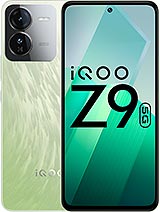
iQOO Z9 5G
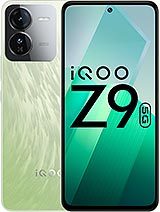
iQOO Z9

iQOO Z10x

F29 5G