Vivo V30 Lite review
The V30 Lite suits everyday users in price-sensitive markets who value a bright, smooth screen and stable battery over gaming grunt or premium cameras. Skip it if you game regularly, need fast charging, or expect your phone to age gracefully—the mid-tier processor and sparse update promise mean it'll feel dated sooner than you'd hope.

This review is based on Vivo’s published specifications and public benchmark data for the Vivo V30 Lite, and the rating is spec-based. GoSolo does not physically test devices; where we estimate real-world behaviour such as battery life or charge time, we say so. How we rate phones.
Overview
The V30 Lite pairs a bright 120Hz AMOLED screen with a smooth-scrolling experience and all-day battery, but the Snapdragon 695 5G limits it to casual gaming and everyday tasks. For the price, it's a solid screen-first phone that won't feel sluggish in daily use, though demanding games will stutter and there's no meaningful performance cushion if you want anything beyond apps and social media.
Design & build
At 190g and 7.7mm thick, the V30 Lite sits comfortably between compact and unremarkable. Glass front and back with a plastic frame feel familiar for a 480-euro phone, though the finish attracts fingerprints and the glass scratches without a case. The IP54 rating defends against dust and splashes, so it won't crumble if caught in rain or dropped in a puddle, but submersion or accidental dunking will damage it. The phone is light enough to pocket all day and doesn't feel bloated, which matters in markets where you'll be carrying it in a bag or tight jeans. Build feels adequately solid, neither flimsy nor premium, and the weight distribution is neutral.
Display
The 6.67-inch 1080p AMOLED screen with 120Hz refresh is the phone's headline strength. At 1150 nits peak brightness, it stays legible in direct sunlight without washing out colors—a real advantage over the typical 60Hz LCDs at this price. The 395 ppi density is sharp enough for text and photos, and because it's AMOLED, blacks are true black, which makes scrolling through apps feel smoother than it would on a cheaper IPS panel. The 20:9 aspect ratio and 88% screen-to-body ratio mean there's minimal bezel waste. For a 480-euro phone, this is a generous display: you're getting tech that rivals in this segment either omit entirely or water down with 90Hz and lower brightness.
Performance
The Snapdragon 695 5G is a solid mainstream processor that handles social apps, browsing, messaging, and light gaming without falter. Apps open quickly, scrolling doesn't stutter, and multitasking feels stable with 8GB or 12GB RAM. Where it falters is demanding games like Genshin Impact at high settings—you'll see frame drops and thermal throttling if you push it. If you're a casual gamer who dabbles in Candy Crush or occasional PUBG, you won't notice the strain, but anyone hoping for a future-proof gaming phone should look elsewhere. The 256GB storage with no microSD slot means you're stuck with what you buy, which is enough for most users but leaves no room to hoard games or high-res video footage. By 2023 standards this chip was already midrange; in 2026 it feels a generation behind.
Software
Android 13 with Funtouch 13 overlay is the ship-state: reasonably fast, though Vivo's customizations can feel bloated if you prefer stock Android. The overlay adds features like gesture controls and system-level customization, but also pre-installed bloat that you may never use. Updates will likely be slow and sparse on this model, so don't expect security patches for years—a real consideration if data security matters to you in your region. The interface works, but it's not a clean or streamlined experience.
Camera
The 64MP f/1.8 main sensor with optical image stabilization and phase-detection autofocus captures sharp, well-balanced daytime shots with accurate color. The OIS steadies handheld photography in indoor lighting and modest video work, and the f/1.8 aperture lets in enough light for evening snaps. The 50MP selfie camera is generous by midrange standards and produces flattering portraits. The weak point is the 8MP f/2.2 ultrawide—it delivers the expected field of view for group shots but loses detail and dynamic range compared to the main sensor, making it feel like a compromised afterthought. Video maxes out at 1080p@30fps, which is acceptable but dated for a late-2023 phone. Night mode is absent, so low-light performance relies entirely on the sensor's native ability, which is average.
Battery & charging
The 4800 mAh battery comfortably delivers a full day of mixed use—about 16 to 20 hours depending on screen brightness and what you're running. If you're a heavy social media user or gamer, expect closer to 14 hours. 44W charging refills the battery from empty in roughly 45 to 60 minutes, which is acceptable but not quick by today's standards; rivals at this price now push 65W to 100W. There's no wireless charging, which is standard to omit at this tier. The battery degrades at the usual rate, so expect noticeably shorter runtimes after two years of daily use.
Value & verdict
At roughly 480 euros, the V30 Lite makes a clear bet: screen quality and all-day battery matter more than raw speed or photography prowess. For daily commuters, students, and social media users in cost-conscious markets, that trade-off works. The 120Hz AMOLED screen alone justifies the price over flat, dull 60Hz rivals, and the Snapdragon 695 is enough to avoid frustration. Where it stumbles is against phones with faster processors or better zoom cameras at similar prices; if you plan to game seriously or shoot in poor light, you'll feel the compromise within weeks. The lack of meaningful upgrade from previous-year midrange models and the absence of 4K video recording make it feel generic rather than a clever bargain. It's a competent, pleasant phone that doesn't offend, but it doesn't excite either.
Verdict
The V30 Lite suits everyday users in price-sensitive markets who value a bright, smooth screen and stable battery over gaming grunt or premium cameras. Skip it if you game regularly, need fast charging, or expect your phone to age gracefully—the mid-tier processor and sparse update promise mean it'll feel dated sooner than you'd hope.
- 1150-nit 120Hz AMOLED screen is sharp and bright, standing out against cheaper 60Hz rivals in this price range
- Optical image stabilization and f/1.8 aperture make handheld photography steady and well-lit in everyday conditions
- All-day battery life with modest charging overhead, no stress about reaching evening on a single charge
- Slim 7.7mm profile and 190g weight make it pocket-friendly without sacrificing screen real estate
- Snapdragon 695 5G struggles with demanding games and demanding apps, feeling sluggish for power users by 2026
- 44W charging is ordinary now; competitors at this price deliver 65W to 100W, reducing a key convenience
- 8MP ultrawide camera is mediocre—soft detail and poor dynamic range make it feel like a checkbox feature rather than a usable second lens
Vivo V30 Lite Key Specifications
The essentials at a glance. See the full spec sheet.
| Released | 2023, December 29 |
|---|---|
| Display | 6.67 inches, 107.4 cm2 (~88.3% screen-to-body ratio), AMOLED, 120Hz, 1150 nits (peak) |
| Resolution | 1080 x 2400 pixels, 20:9 ratio (~395 ppi density) |
| Chipset | Qualcomm SM6375 Snapdragon 695 5G (6 nm) |
| RAM & storage | 256GB 8GB RAM, 256GB 12GB RAM |
| Main camera | 64 MP, f/1.8, (wide), PDAF, OIS 8 MP, f/2.2, (ultrawide) Auxiliary lens |
| Selfie camera | 50 MP, f/2.0, 22mm (wide), AF |
| Battery | 4800 mAh |
| Charging | 44W wired |
| Software | Android 13, Funtouch 13 |
| Dimensions | 162.4 x 74.9 x 7.7 mm (6.39 x 2.95 x 0.30 in) |
| Weight | 190 g (6.70 oz) |
| Build | Glass front, plastic frame, glass back |
| Durability | IP54 dust protected and water resistant (water splashes) |
| Network | GSM / HSPA / LTE / 5G |
| NFC | Yes |
| USB | USB Type-C 2.0, OTG |
Vivo V30 Lite FAQ
Common questions, answered from the spec sheet.
Does the V30 Lite support 5G?
Yes. The V30 Lite supports 5G networks.
What chipset does the V30 Lite use?
The V30 Lite runs on the Qualcomm SM6375 Snapdragon 695 5G (6 nm).
What display does the V30 Lite have?
A 6.67 inches, 107.4 cm2 (~88.3% screen-to-body ratio) AMOLED, 120Hz, 1150 nits (peak), 1080 x 2400 pixels, 20:9 ratio (~395 ppi density).
How big is the V30 Lite battery?
The V30 Lite has a 4800 mAh battery. Charging is rated at 44W wired.
Does the V30 Lite have NFC?
Yes, the V30 Lite has NFC.
Is the V30 Lite water resistant?
The V30 Lite carries a IP54 dust protected and water resistant (water splashes) rating.
Does the V30 Lite support a microSD card?
No, the V30 Lite does not support expandable storage.
Does the V30 Lite have a headphone jack?
No, the V30 Lite does not have a 3.5mm headphone jack.
Alternatives to consider
If the V30 Lite isn’t quite right, these are the closest calls.
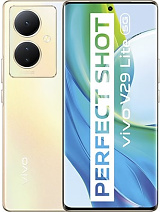
V29 Lite 5G
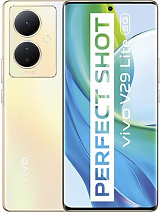
V29 Lite

V30 Lite 4G

V40 Lite 4G

Galaxy M15 5G