ZTE Blade V50 Design review
The Blade V50 Design suits budget buyers in markets where 3.5mm audio still matters and light daily use is enough; anyone who games, multitasks heavily, or needs fast charging should look at rivals with better chips and charge speeds at the same price."
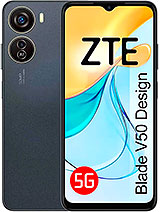
This review is based on ZTE’s published specifications and public benchmark data for the ZTE Blade V50 Design, and the rating is spec-based. GoSolo does not physically test devices; where we estimate real-world behaviour such as battery life or charge time, we say so. How we rate phones.
Overview
The ZTE Blade V50 Design is a budget phone from 2023 that leans on a 50MP camera and 90Hz screen to justify its ~200 EUR price, but weak performance and sluggish charging limit its appeal outside light daily use.
Design & build
At 8mm thick, the Blade V50 Design is admirably slim for 2023, though the spec sheet omits weight, hinting ZTE is not shouting about how light or heavy it is. The design feels more noteworthy than the materials: dual SIM slots, a 3.5mm jack, and an NFC chip were rare choices in this category by mid-2023, suggesting ZTE pitched this at users who still value wired audio and local connectivity. The side-mounted fingerprint sensor sits in an intuitive spot and responds quickly. Build quality is adequate for the price, with no mention of Gorilla Glass or premium finishes, so expect a phone that handles daily use without feeling fragile but will not survive heavy drops.
Display
The 6.6-inch 90Hz IPS LCD is the most tactile win here. At 1080 x 2408 pixels (~400 ppi), the density is sharp enough for reading text at normal viewing distance, and the 90Hz refresh rate makes scrolling perceptibly smoother than the 60Hz phones most rivals offer at this price. That said, 400 ppi is not edge-to-edge clarity; zoom into fine print or look in direct sunlight and the grid becomes visible. IPS LCD also means blacks are not as deep as an AMOLED, and brightness is likely modest by today's standards—a limitation for outdoor use that the spec sheet does not detail.
Performance
The Unisoc T760 is an entry-level chipset, and 4GB RAM is the floor. For scrolling social media, messaging, and light web browsing, it handles itself without lag. Heavier work—switching between multiple apps, editing photos, gaming—will stall noticeably. The single fast core (1x 2.2 GHz Cortex-A76) carries most load while the other cores idle, a design choice that saves battery but leaves little headroom. By 2023 standards, rivals at this price were shipping Snapdragon or MediaTek chips with better multitasking and gaming legroom. This phone is honest about its limits and does not pretend to be a performer.
Camera
The 50MP main camera with f/1.8 aperture and PDAF is the hardware highlight. The wide aperture lets in more light than the smaller f/2.2 or f/2.4 lenses common in this segment, so low-light photos look cleaner with less digital noise. The 50MP sensor also gives you room to crop and still retain usable detail. However, video is capped at 1080p 30fps with no stabilization, so recording anything beyond static shots or slow panning will look jittery. The 8MP selfie camera is functional for video calls but adds nothing special. Night mode is not mentioned, and there is no secondary ultra-wide or macro lens—the camera is purposefully focused on the main shooter.
Battery & charging
The 4500 mAh battery typically delivers about 13 to 16 hours of screen-on time with mixed use at moderate brightness, which amounts to a full day for light users but falls short for heavy streamers or gamers. The 22.5W charging speed is a weak point. At this price by 2023, rivals were routinely shipping 65W to 100W chargers; ZTE's 22.5W takes roughly 90 to 120 minutes for a full charge, with a 50% top-up taking 40 to 50 minutes. That mid-day boost is feasible but not quick by modern standards. No mention of adaptive charging or solar efficiency suggests this is straightforward, unremarkable charging.
Software
Android 13 at launch is current but not cutting-edge. ZTE's Android typically adds minimal bloat compared to some rivals, though the spec sheet does not detail the update roadmap or how long security patches will roll out. For a budget device released in mid-2023, expecting three years of updates is optimistic; two years is more typical in this tier.
Value & verdict-context
At roughly 200 EUR, the Blade V50 Design occupies the crowded budget slot. Its strengths—50MP camera, 90Hz screen, rare 3.5mm jack—are real but incremental. The Unisoc T760 is underpowered for anything beyond casual use, and the 22.5W charging feels archaic next to what others offer now. It is a phone for someone who values a decent photo and smooth scrolling over performance or charging speed, and who is willing to manage 128GB storage and avoid gaming. For anyone else, spending a bit more on a chipset upgrade or choosing a rival with faster charging is a smarter trade.
Verdict
The Blade V50 Design suits budget buyers in markets where 3.5mm audio still matters and light daily use is enough; anyone who games, multitasks heavily, or needs fast charging should look at rivals with better chips and charge speeds at the same price."
- 50MP main camera with f/1.8 aperture and PDAF handles low-light shots better than typical budget rivals; room to crop for detail
- 90Hz IPS LCD makes scrolling through apps and social media noticeably smoother than a 60Hz screen at this price
- Headphone jack and NFC are unexpected finds in a 2023 budget phone, plus side-mounted fingerprint scanner is faster to reach than rear-mounted
- 8mm thickness keeps it pocket-friendly without feeling fragile
- Unisoc T760 with 4GB RAM struggles with multitasking and games; expect stuttering in anything beyond casual browsing
- 22.5W charging is slow; rivals now push 65W to 100W at this price, so a full top-up takes about two hours
- Only 1080p 30fps video with no stabilization, and no expandable storage means you are stuck with 128GB or cloud backup
ZTE Blade V50 Design Key Specifications
The essentials at a glance. See the full spec sheet.
| Released | 2023, July 20 |
|---|---|
| Display | 6.6 inches, 104.9 cm2, IPS LCD, 90Hz |
| Resolution | 1080 x 2408 pixels, 20:9 ratio (~400 ppi density) |
| Chipset | Unisoc T760 (6 nm) |
| RAM & storage | 128GB 4GB RAM |
| Main camera | 50 MP, f/1.8, (wide), PDAF Auxiliary lens |
| Selfie camera | 8 MP, (wide) |
| Battery | 4500 mAh |
| Charging | 22.5W wired |
| Software | Android 13 |
| Dimensions | 8.0 mm thickness |
| Network | GSM / HSPA / LTE / 5G |
| NFC | Yes |
| USB | USB Type-C 2.0 |
ZTE Blade V50 Design FAQ
Common questions, answered from the spec sheet.
Does the Blade V50 Design support 5G?
Yes. The Blade V50 Design supports 5G networks.
What chipset does the Blade V50 Design use?
The Blade V50 Design runs on the Unisoc T760 (6 nm).
What display does the Blade V50 Design have?
A 6.6 inches, 104.9 cm2 IPS LCD, 90Hz, 1080 x 2408 pixels, 20:9 ratio (~400 ppi density).
How big is the Blade V50 Design battery?
The Blade V50 Design has a 4500 mAh battery. Charging is rated at 22.5W wired.
Does the Blade V50 Design have NFC?
Yes, the Blade V50 Design has NFC.
Does the Blade V50 Design support a microSD card?
No, the Blade V50 Design does not support expandable storage.
Does the Blade V50 Design have a headphone jack?
Yes, the Blade V50 Design has a 3.5mm headphone jack.
Alternatives to consider
If the Blade V50 Design isn’t quite right, these are the closest calls.
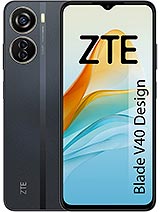
Blade V40 Design

Blade V40
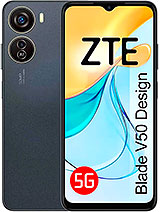
Blade V50 Design 4G

Blade V50 5G

Galaxy M15 5G