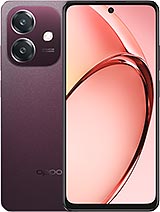
ZTE V70 review
The V70 suits someone who values a large AMOLED screen and quick charging over raw horsepower and videography, particularly in a 5G market. It falls short for gamers, video creators, or anyone who wants a more future-proof chip than the aging Dimensity 810.
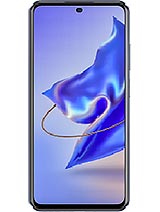
This review is based on ZTE’s published specifications and public benchmark data for the ZTE V70, and the rating is spec-based. GoSolo does not physically test devices; where we estimate real-world behaviour such as battery life or charge time, we say so. How we rate phones.
Overview
The ZTE V70 is a mid-range 5G phone built around a large AMOLED screen and genuinely quick 66W charging, but held back by an older Dimensity 810 chipset and 1080p video capture that felt dated even in 2023. It is a solid daily driver for someone in a 5G region who values screen and charging speed over gaming or videography.
Design & build
At 192g and 8.3mm thin, the V70 is lightweight and pocketable—dimensions that feel balanced for a 6.67-inch phone, though we lack detail on the frame material in the spec sheet. The 86% screen-to-body ratio is visibly lean on bezels compared to budget phones from the era. The olive green colour option adds a touch of personality in a sea of blacks and silvers. Side-mounted fingerprint is the practical choice here, faster to unlock than under-display alternatives when your phone is resting on a table.
Display
The AMOLED screen is the V70's strongest card. At 6.67 inches and 1080 by 2400 pixels, it delivers rich colours and deep blacks—hallmarks of AMOLED at this size. Pixel density sits at 395 ppi, which is sharp enough for most people at arm's length; you will not spot individual pixels in daily use. The 20:9 aspect ratio and large footprint suit video streaming and gaming, though the 1080p resolution means scaling is not as fine as 1440p panels on pricier rivals. For a mid-range 2023 phone, this screen punches above its weight.
Performance
The Mediatek Dimensity 810, built on a 6nm process, is competent for everyday apps, messaging, social media, and light gaming at stable frame rates. The Mali-G57 MC2 GPU is not powerful. Apps and games that demanded sustained heavy performance—intensive video games, photo editing, 4K video work—will expose its limits; you will see throttling and frame drops. By mid-2023, this chipset was already one generation behind what rivals at the same price were shipping. If you are scrolling through emails and streaming Netflix, fine. If you are chasing high frame rates or processing-heavy tasks, look elsewhere.
Software
Android 11 with MyOS 11.5 on top is ageing by 2023 standards. Android 11 had already seen two major releases pass it by, and MyOS is ZTE's light skin that does not substantially alter the core experience. Update support is not specified, and ZTE has a patchy track record on long-term software maintenance outside China. This is a potential downside for buyers in regions where vendor support matters—expect at most two to three years of meaningful updates if you are lucky.
Camera
The 64MP main sensor with f/1.8 lens and PDAF captures fine detail in bright daylight, handling landscape and detail shots reasonably well. The 8MP ultrawide at 120 degrees is useful for group shots and landscapes, though it trades sharpness for breadth. A 5MP macro rounds out the array but is largely a gimmick. The weak link: 1080p at 30fps video was already basic in mid-2023, when rivals routinely offered 4K 60fps or higher. If video is any priority, this phone will disappoint. The 16MP selfie camera is adequate for video calls and casual self-portraits, nothing more.
Battery & charging
66W wired charging is the standout feature here. Hitting 50% in 15 minutes means you can grab a meaningful top-up during a coffee break or commute, and full charge takes roughly 30 to 40 minutes—genuinely quick for 2023's mid-range. The 5100 mAh battery itself is modest; expect roughly one day of moderate use, or less if you are on heavy social media, gaming, or video streaming. At moderate brightness and mixed usage, you will comfortably reach evening; heavy users will want to plug in by afternoon. The fast charging partially offsets the smaller battery, making it practical for people who do not mind a mid-day top-up.
Value & verdict
In mid-2023, the V70 occupied an awkward middle ground. At its price point, it competed with phones that offered faster chips (Snapdragon 780G, Dimensity 900 series) or better video capture. The 66W charging and AMOLED screen are strong cards, but the Dimensity 810 and 1080p video ceiling limit its appeal. For someone in a 5G region who prioritizes fast charging and a large sharp display over gaming or video work, it checks boxes. For content creators or gamers, it falls short. The lack of microSD expansion and modest battery capacity reinforce that this is a phone for steady daily use, not power users.
Verdict
The V70 suits someone who values a large AMOLED screen and quick charging over raw horsepower and videography, particularly in a 5G market. It falls short for gamers, video creators, or anyone who wants a more future-proof chip than the aging Dimensity 810.
- 66W wired charging reaches 50% in 15 minutes, full charge in roughly 30–40 minutes—genuinely fast for the mid-range tier in 2023
- 6.67-inch AMOLED display with 395 ppi is large, sharp, and colour-rich; 86% screen-to-body ratio keeps bezels minimal
- 5G SA/NSA support and dual-band Wi-Fi 5 ensure future-ready connectivity where networks exist
- Side-mounted fingerprint, 3.5mm jack, and dual SIM flexibility for practical everyday use
- Dimensity 810 was already a year behind flagship chips in mid-2023; it handles day-to-day tasks but stumbles in sustained heavy gaming and demanding apps
- 1080p video at 30fps was underwhelming even by 2023 standards, limiting content creation appeal
- 5100 mAh battery, while supporting fast charge, is modest in capacity; expect roughly one day of moderate-to-heavy use, not more
ZTE V70 Key Specifications
The essentials at a glance. See the full spec sheet.
| Released | 2023, June 05 |
|---|---|
| Display | 6.67 inches, 107.4 cm2 (~86.0% screen-to-body ratio), AMOLED, 1B colors |
| Resolution | 1080 x 2400 pixels, 20:9 ratio (~395 ppi density) |
| Chipset | Mediatek Dimensity 810 (6 nm) |
| RAM & storage | 256GB 8GB RAM |
| Main camera | 64 MP, f/1.8, 25mm (wide), PDAF 8 MP, f/2.2, 16mm, 120˚ (ultrawide) 5 MP (macro) |
| Selfie camera | 16 MP, (wide) |
| Battery | 5100 mAh |
| Charging | 66W wired, 50% in 15 min |
| Software | Android 11, MyOS 11.5 |
| Dimensions | 163.9 x 76.2 x 8.3 mm (6.45 x 3.00 x 0.33 in) |
| Weight | 192 g (6.77 oz) |
| Network | GSM / HSPA / LTE / 5G |
| NFC | Yes |
| USB | USB Type-C 2.0 |
ZTE V70 FAQ
Common questions, answered from the spec sheet.
Does the V70 support 5G?
Yes. The V70 supports 5G networks.
What chipset does the V70 use?
The V70 runs on the Mediatek Dimensity 810 (6 nm).
What display does the V70 have?
A 6.67 inches, 107.4 cm2 (~86.0% screen-to-body ratio) AMOLED, 1B colors, 1080 x 2400 pixels, 20:9 ratio (~395 ppi density).
How big is the V70 battery?
The V70 has a 5100 mAh battery. Charging is rated at 66W wired, 50% in 15 min.
Does the V70 have NFC?
Yes, the V70 has NFC.
Does the V70 support a microSD card?
No, the V70 does not support expandable storage.
Does the V70 have a headphone jack?
Yes, the V70 has a 3.5mm headphone jack.
Alternatives to consider
If the V70 isn’t quite right, these are the closest calls.
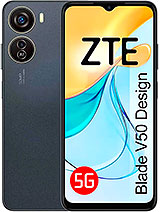
Blade V50 Design

Blade V50
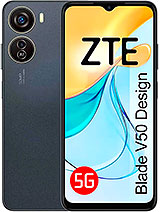
Blade V50 Design 4G
Blade V40
Galaxy M15 5G