Xiaomi Poco M6 Plus review
The M6 Plus suits everyday users and light media consumers who prioritise screen size, smoothness, and battery life over performance or video quality. Skip it if you game regularly, need fast charging, or shoot video; at this price, rivals with faster chips and 4K recording are worth the extra 20 to 30 EUR.
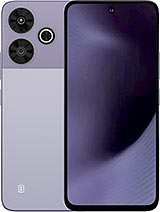
This review is based on Xiaomi’s published specifications and public benchmark data for the Xiaomi Poco M6 Plus, and the rating is spec-based. GoSolo does not physically test devices; where we estimate real-world behaviour such as battery life or charge time, we say so. How we rate phones.
Overview
The Poco M6 Plus combines a large, smooth 120Hz screen and solid all-day battery with a modest Snapdragon 4 chipset—fine for everyday use and light gaming, but unexciting for the money and outmatched by budget rivals with more powerful silicon.
Design and Build
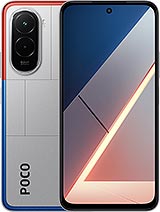
At 205g and 8.3mm thick, the M6 Plus is solid and manageable without feeling flimsy, though the plastic frame undercuts the glass-sandwich exterior. IP53 dust and splash resistance handles light rain and kitchen spills, but it is not submersible and will not survive a drop. Gorilla Glass 3 is mid-range protection; a fall from pocket height onto concrete will crack it. The side-mounted fingerprint sensor is responsive and reliable. Overall the phone feels built for the price—not durable, but competent for careful daily use.
Display
The 6.79-inch 1080p IPS LCD is the phone's headline strength. Refresh rate locks at 120Hz, and scrolling through apps, social feeds, and web pages feels genuinely smooth compared to the standard 60Hz you often see at this price. At 550 nits peak brightness, outdoor visibility is solid in sunlight without aggressive glare; the wide screen-to-body ratio (85.1%) means less bezel wasted. Colours are warm and accurate for an IPS panel, though viewing angles do narrow at extreme tilts. The 396 ppi pixel density is enough that text stays sharp. For a budget phone, this is where Xiaomi focused, and it pays off.
Performance
The Snapdragon 4 Gen 2 AE is entry-level silicon that keeps everyday tasks—calls, messaging, web browsing, video playback—running without stutter. Apps load on time and switching between open windows does not cause lag. Where the chip shows its limits is sustained demand: gaming at high settings causes visible frame drops and heats the phone up, and heavy multitasking (many tabs, video editing software, large file transfers) will slow things down. By late 2024 standards, rivals in the same price band have moved up to Snapdragon 6 Gen 1 or MediaTek equivalents, which offer meaningfully smoother gaming and faster file handling. The M6 Plus is reliable for casual users but compromised for anyone who games regularly or works with heavy apps.
Camera
The 108MP main camera with f/1.8 aperture and PDAF performs well in daylight, capturing sharp, well-exposed shots with good detail recovery. The wide aperture helps in lower light where lower-MP rivals struggle. The 0.64µm pixel size is tiny, which means it benefits from binning (combining pixels for noise reduction), and daylight HDR works reliably. The 2MP macro lens is token-grade—more a spec-sheet entry than a practical tool. There is no telephoto, so any zoom is digital and degrades quality immediately. Selfie at 13MP with f/2.5 is competent for video calls but dark indoors. The biggest miss is 1080p 30fps video, which feels dated for 2024; rivals now shoot 4K 30fps as standard, and 30fps caps smooth action and low-light recording. Portrait mode exists but struggles without a dedicated depth sensor.
Software and Updates
HyperOS runs Android 14 with Xiaomi's customisations. The interface is intuitive and responsive on the Snapdragon 4's performance level. Xiaomi promises two major Android upgrades, which takes you to Android 16 by late 2026—reasonable for a budget phone but behind flagship support. The preloaded bloatware is minimal by Xiaomi standards. Out of the box, the phone feels clean, and you can disable most default apps. Updates are likely to arrive on schedule, though security patches may lag behind flagship priority.
Battery and Charging
The 5030 mAh battery delivers about 1.5 days of mixed use—web browsing, social media, calls, some video. Heavy gaming or video streaming shortens that to closer to a full day; light use stretches past two. For most people, a morning charge gets you through until bedtime with battery to spare. The 33W wired charger tops you up from empty in about 60 to 75 minutes, which is adequate but not fast by current standards; rivals now offer 65W and 100W charging at this price. There is no wireless charging, which is standard to omit here. The takeaway is that daily charging is routine, and you are not stranded without power, but there is no buffer for multi-day trips.
Value and Verdict
At around 140 EUR, the M6 Plus sits in a crowded segment where specs have inflated rapidly. You get a smooth, large screen and comfortable battery life, which alone is worth the money for someone who scrolls a lot. The Snapdragon 4 and 30fps video, though, lag behind what budget rivals offer now, and the camera lacks the telephoto or video clarity that would justify the high megapixel count. The inclusion of a headphone jack and microSD slot is rare and valuable. Xiaomi has built a phone that feels unrushed and reliable, not fast or feature-rich. For the money, it is neither a standout buy nor a trap—it is an honest mid-pack choice that rewards patient shoppers who do not game or shoot video.
Verdict
The M6 Plus suits everyday users and light media consumers who prioritise screen size, smoothness, and battery life over performance or video quality. Skip it if you game regularly, need fast charging, or shoot video; at this price, rivals with faster chips and 4K recording are worth the extra 20 to 30 EUR.
- 6.79-inch 120Hz LCD screen is large and fluid for scrolling and video, with 550 nits brightness adequate for outdoor readability
- 5030 mAh battery lasts about 1.5 days with mixed use; 33W charging gets you full in just over an hour
- 108MP main camera with f/1.8 and PDAF captures decent detail and light in daylight shots
- 3.5mm headphone jack and microSD expansion on a budget phone in 2024 is rare and practical
- Snapdragon 4 Gen 2 AE is entry-level and struggles with demanding games or heavy multitasking; rivals at this price now offer Snapdragon 6 Gen 1 or MediaTek chips with noticeably faster performance
- 1080p video maxed at 30fps limits smooth action recording and low-light video quality
- Only 2MP macro and no telephoto means zoom is digital-only; portrait mode and close-up detail fall short of what a 108MP sensor could deliver with better optics
Xiaomi Poco M6 Plus Key Specifications
The essentials at a glance. See the full spec sheet.
| Released | 2024, August 01 |
|---|---|
| Display | 6.79 inches, 109.5 cm2 (~85.1% screen-to-body ratio), IPS LCD, 120Hz, 550 nits (peak) |
| Resolution | 1080 x 2460 pixels (~396 ppi density) |
| Chipset | Qualcomm SM4450 Snapdragon 4 Gen 2 AE (4 nm) |
| RAM & storage | 64GB 4GB RAM, 128GB 6GB RAM, 128GB 8GB RAM |
| Main camera | 108 MP, f/1.8, 28mm (wide), 0.64µm, PDAF 2 MP (macro) |
| Selfie camera | 13 MP, f/2.5, (wide) |
| Battery | 5030 mAh |
| Charging | 33W wired |
| Software | Android 14, up to 2 major Android upgrades, HyperOS |
| Dimensions | 168.6 x 76.3 x 8.3 mm (6.64 x 3.00 x 0.33 in) |
| Weight | 205 g (7.23 oz) |
| Build | Glass front, plastic frame, glass back |
| Durability | IP53 dust protected and water resistant (vertical water sprays) |
| Network | GSM / HSPA / LTE / 5G |
| NFC | No |
| USB | USB Type-C |
Xiaomi Poco M6 Plus FAQ
Common questions, answered from the spec sheet.
Does the Poco M6 Plus support 5G?
Yes. The Poco M6 Plus supports 5G networks.
What chipset does the Poco M6 Plus use?
The Poco M6 Plus runs on the Qualcomm SM4450 Snapdragon 4 Gen 2 AE (4 nm).
What display does the Poco M6 Plus have?
A 6.79 inches, 109.5 cm2 (~85.1% screen-to-body ratio) IPS LCD, 120Hz, 550 nits (peak), 1080 x 2460 pixels (~396 ppi density).
How big is the Poco M6 Plus battery?
The Poco M6 Plus has a 5030 mAh battery. Charging is rated at 33W wired.
Does the Poco M6 Plus have NFC?
No, the Poco M6 Plus does not list NFC support.
Is the Poco M6 Plus water resistant?
The Poco M6 Plus carries a IP53 dust protected and water resistant (vertical water sprays) rating.
Does the Poco M6 Plus support a microSD card?
Yes, the Poco M6 Plus supports expandable storage (microSDXC (uses shared SIM slot)).
Does the Poco M6 Plus have a headphone jack?
Yes, the Poco M6 Plus has a 3.5mm headphone jack.
Alternatives to consider
If the Poco M6 Plus isn’t quite right, these are the closest calls.
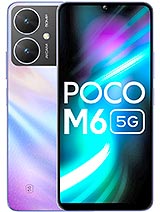
Poco M6 4G
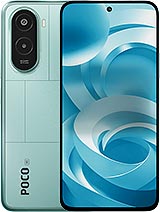
Poco M7 Plus
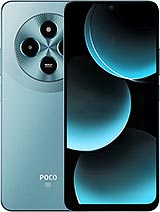
Poco M7
Poco M7 4G

Galaxy M16 5G